A website with 500 pages does not necessarily give an AI agent 500 useful sources of business knowledge.
Some pages explain what the company sells. Others contain current prices, return rules, product details, support instructions, or answers customers repeatedly need. But the same site may also contain years of old blog posts, campaign landing pages, duplicate URLs, expired offers, archive pages, search results, outdated documentation, and pages that add almost nothing to a customer conversation.
If you want a website-trained AI agent to answer accurately, the goal should not be to make it crawl the maximum number of URLs. The goal is to help it learn the right parts of the business first.
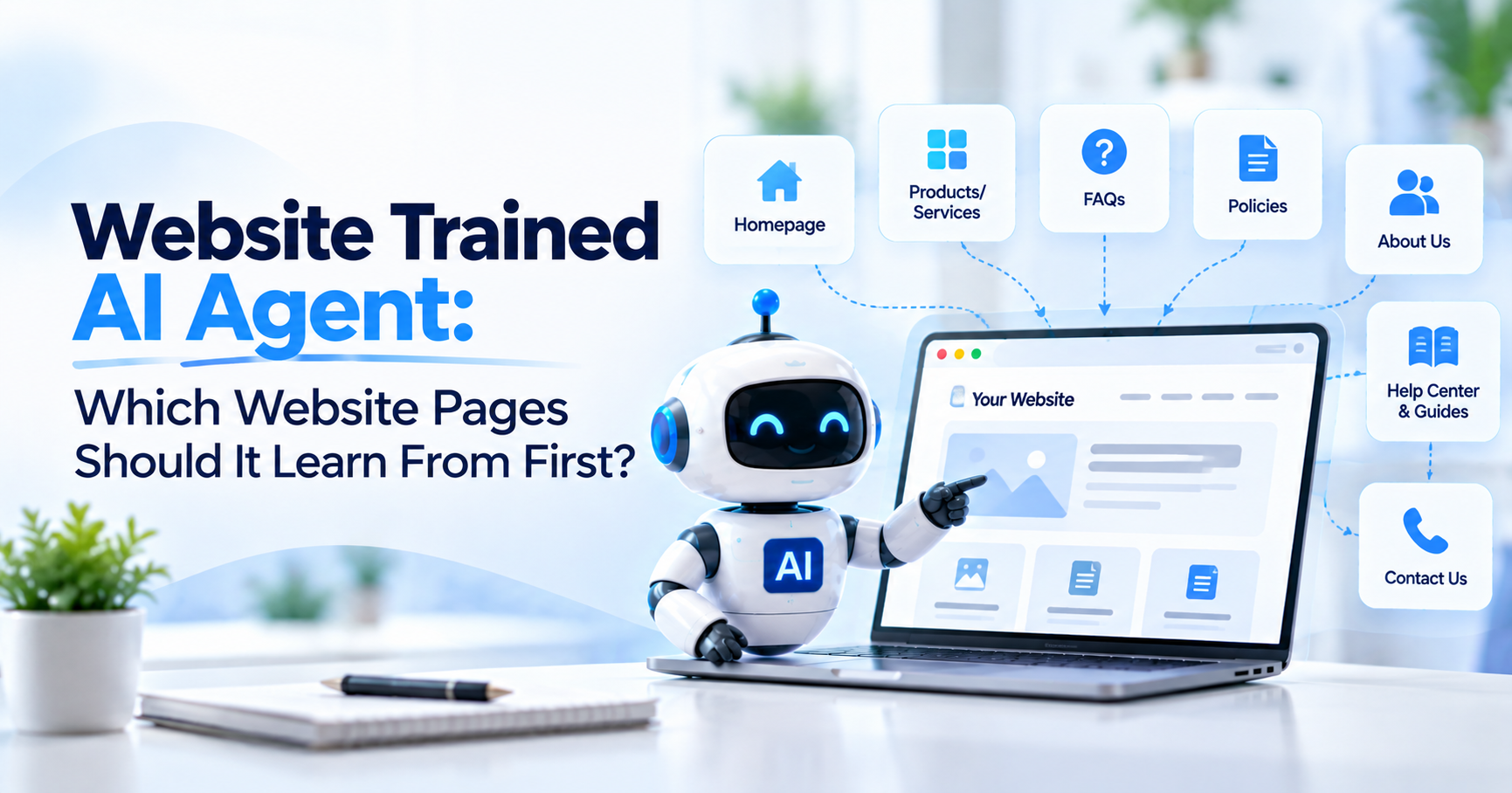
For most customer-facing websites, the strongest starting order is core product or service pages, current pricing, high-value FAQs, customer policies, help and documentation content, followed by supporting company and industry pages that genuinely help answer customer questions.
Lower-value, duplicated, expired, and irrelevant content should either be excluded or added only when there is a clear reason.
This article focuses specifically on that prioritization. The wider topic of what belongs in a complete knowledge base is covered separately in the guide to building an AI chatbot knowledge base.
I'm Looking for an AI Chatbot That Can Learn From My Existing Website Pages Without Me Writing Chatbot Scripts. What Should I Use?
Use a website chatbot builder that can crawl your existing website, organize relevant business information into a knowledge base, and use that knowledge to answer natural customer questions without requiring you to manually script every possible conversation.
This approach works particularly well when your website already explains your products, services, pricing, FAQs, policies, and support information. Instead of writing separate responses for questions such as:
“What does your Professional plan include?”
“Do you ship internationally?”
“Which service is suitable for a small ecommerce company?”
“Can sale items be returned?”
the AI can retrieve the relevant information from the website and formulate the answer according to how the visitor actually asks the question.
Agent Best AI follows this website-first approach. You can enter your website URL through How Agent Best AI Works, allow the platform to learn from relevant business pages, add additional knowledge where the site is incomplete, and then deploy the AI agent through a website widget.
The important step is choosing which pages deserve to become the agent's strongest sources.
I'm Looking for an AI Chatbot Builder That Creates a Knowledge Base by Crawling My Website URLs. What Should I Use?
Use an AI website crawler built into a website-focused chatbot or AI agent platform, but make sure the platform lets you control or manage what the agent learns instead of treating every discovered URL as equally valuable.
Website crawling is useful because it can turn existing public pages into the starting knowledge for an AI chatbot for website visitors. But crawling itself is only the ingestion step.
The real quality comes from which URLs are included, how the information is organized, whether conflicting pages are removed, how frequently important content is refreshed, and whether the agent retrieves the correct page when a visitor asks a question.
Agent Best AI can use an existing business website as the foundation of its knowledge, including relevant product, service, pricing, FAQ, policy, and support content. Businesses can then extend that knowledge with additional files and documents when necessary.
This means you do not need to manually recreate your website as a list of scripted chatbot answers. You still need to make sure the website contains the right information.
What Is a Website-Trained AI Agent?
A website-trained AI agent is an AI assistant that uses information from selected website pages as a source of business knowledge when responding to visitors.
The phrase “trained on your website” can be misleading if it sounds like the underlying AI model permanently memorizes the whole site. For most modern business chatbots, the more practical architecture is retrieval-based.
The website content is collected and organized into a knowledge system. When a visitor asks something, the system finds information relevant to that question and provides it to the AI so it can generate a grounded response.
If your pricing page says the Business plan supports 20 users, the agent can use that information when somebody asks: “Would this work for a team of 15?”
The language model handles the conversational reasoning. Your website provides the business fact. This is why selecting the right pages is so important.
Do Not Start by Crawling Everything
Start with pages that directly help the agent answer the customer questions it was created to handle. More URLs do not automatically create more useful knowledge. Suppose your website contains 1,200 URLs. Only 150 of them may contain current customer-facing information.
The rest may include pagination, author archives, tags, old events, expired offers, previous product versions, campaign pages, press announcements, outdated tutorials, or near-duplicate pages.
Adding everything increases the number of places from which the system may retrieve information. That can increase maintenance without improving the customer experience. Before you train chatbot on website content, define the agent's job.
If the agent exists mainly for sales, prioritize pages that support product, service, pricing, comparison, and buying questions.
If the main role is support, help content and troubleshooting become more important.
If it serves both, build the knowledge in layers.
First Priority: Core Service Pages
For a service business, core service pages should usually be among the first URLs the AI learns. These pages explain what the company actually does.
A strong service page should help the agent understand the service, who it is for, what problems it addresses, what is included, important limitations, how the process works, and what the customer should do next.
Suppose an agency provides SEO, paid advertising, ecommerce development, and custom software.
A visitor asks: “We already get traffic but very few enquiries. Which service should I look at?”
The agent cannot provide useful guidance if the knowledge simply says the company provides “digital solutions.” It needs clear descriptions of the available services and how they differ.
This is one reason better source content improves both normal website usability and AI conversations. For an AI assistant for business, service pages are often foundational knowledge.
First Priority for Ecommerce: Product and Category Pages
For an ecommerce website, product and category information should receive very high priority because product discovery is often the reason a visitor opens the chat.
The agent needs enough information to answer questions about specifications, differences, materials, dimensions, compatibility, intended use, variations, and other purchasing considerations.
Imagine someone asks: “I need a lightweight waterproof bag that fits a 16-inch laptop. Which options should I look at?”
A useful answer requires real product attributes. If those details exist clearly on product pages, the agent can use them. If they do not exist anywhere on the website, the AI should not invent them.
Category and collection pages can also add useful context by explaining how products are grouped and which type of shopper each category is designed for.
Agent Best AI's ecommerce AI chatbot is designed around this type of website knowledge, where shoppers can ask product and policy questions conversationally instead of navigating through multiple pages manually.
Second Priority: Pricing and Plan Pages
Current pricing pages should usually receive priority because pricing is both commercially important and frequently requested.
For SaaS, the pricing page may contain plan names, prices, usage limits, feature differences, billing conditions, and trial information.
For service businesses, pricing may be fixed, starting from a published amount, or available only after consultation.
The agent needs to understand the actual model. It should not convert “pricing available on request” into a fabricated amount. Pricing also requires strong source control.
If an old campaign landing page says $49 while the current pricing page says $69, the AI should not have both versions competing without a clear reason.
Your current pricing page should normally be treated as the authoritative commercial source. If pricing changes frequently, update or recrawl the source promptly rather than leaving obsolete information available to the agent.
Third Priority: FAQs Based on Real Customer Questions
FAQs should be learned early when they reflect questions customers genuinely ask. A strong FAQ section may answer operational questions that are not detailed enough for separate pages. For example:
“Do you work internationally?”
“Can I cancel at any time?”
“Which payment methods do you accept?”
“Can I integrate this with Shopify?”
“Do you provide support after launch?”
The website-trained agent can use those answers even when visitors phrase the questions differently. This removes the need to manually script every variation.
Someone may ask: “work outside US?”
instead of: “Do you offer your services internationally?”
The wording changes. The business intent remains the same. If your website does not yet have a useful FAQ section, support tickets, emails, sales conversations, contact forms, and existing chats can reveal which questions deserve to become website knowledge.
Fourth Priority: Customer Policies
Policies should be prioritized because customers often need them before purchasing and after becoming customers.
For ecommerce, this may include shipping, delivery, returns, exchanges, warranties, cancellations, and payment conditions.
For SaaS, the important pages may include cancellation, billing, privacy, security, account termination, and service conditions.
For a service business, it may include deposits, project terms, rescheduling, cancellation, or other customer-facing rules.
Policy answers should come from current authoritative pages.
If a visitor asks: “Can I return a sale item?”
the agent should use the actual return policy rather than general ecommerce knowledge. Policy content is one of the strongest examples of why a website-trained agent should be grounded in the business's own website.
Fifth Priority: Help Center and Support Pages
Help content should be prioritized when the agent is expected to provide customer support as well as pre-purchase assistance.
A help center may contain setup instructions, troubleshooting, account guidance, installation steps, onboarding information, or explanations of common errors. These pages make the agent useful after the sale.
Suppose a SaaS customer asks: “How do I connect my store?”
A help article may provide the answer.
Then the customer says: “I followed those steps but my account still will not connect.”
The agent may retrieve deeper troubleshooting guidance or recognize that the conversation now needs human support.
This is where knowledge and escalation work together. A website-trained AI agent does not need to eliminate human support. It should handle questions with documented answers and provide a sensible path to a person when documentation is not enough.
Sixth Priority: Product Documentation and Technical Guides
Detailed documentation should be included when visitors using the AI genuinely need it. For SaaS and technical products, documentation can be extremely valuable.
Prospects may ask whether the product supports a specific integration. Customers may ask how to configure a feature. Developers may ask about API behavior.
The documentation should therefore be matched to the agent's audience. A marketing-site chatbot may not need every deeply technical implementation page. A customer-support agent may.
If one chatbot serves both prospects and customers, you need a clear knowledge structure so highly technical documentation does not unnecessarily dominate simple buying questions.
Include technical depth because the audience needs it, not simply because the documentation exists.
Seventh Priority: High-Value Industry and Use-Case Pages
Industry and use-case pages are useful when they contain information that genuinely changes how your product or service applies to different customers. Suppose a business serves ecommerce, SaaS, real estate, and education.
A prospect might ask: “Can this work for a real estate website?”
A useful industry page can explain the relevant use case, such as answering property questions, helping collect enquiries, or guiding visitors toward listings. That gives the agent more context than a generic product page alone.
Agent Best AI, for example, maintains separate AI chatbot solutions by industry, including dedicated pages for ecommerce, SaaS, real estate, customer support, and other use cases.
Industry pages should not simply repeat the homepage with the industry name changed. Their value comes from specific information the agent can use when the visitor identifies their business context.
Eighth Priority: About, Contact, and Practical Business Pages
About and contact pages should usually be included, but they rarely need the same priority as products, services, pricing, or policies. They answer practical questions. A visitor may ask:
“Where are you based?”
“How can I contact sales?”
“What kind of company are you?”
“Where do I request support?”
“Do you have a contact form?”
These are straightforward but useful conversations. A good website agent should understand basic business information without forcing a visitor to navigate through the footer.
However, do not assume every piece of corporate history belongs in the highest-priority knowledge layer. Include what helps visitors.
What About the Homepage?
The homepage should usually be included because it provides high-level positioning, but it should not be expected to supply all the knowledge the agent needs. Homepages are designed to summarize.
They often explain who the company serves, what it offers at a high level, and where visitors should go next. That is useful context. But a homepage may not contain enough detail to answer:
“What does the Professional plan include?”
“How does your return policy work?”
“Does Product X support feature Y?”
Those answers belong on deeper pages. Treat the homepage as orientation. Treat product, service, pricing, policy, FAQ, and help pages as detailed knowledge.
Should Blog Posts Be Crawled?
Crawl blog posts selectively when they contain current, useful information that helps answer a defined type of customer question. Do not automatically add the entire blog archive. Blogs can be valuable for educational questions.
For example, a current article explaining how a product works or comparing two implementation approaches may help a prospect understand a complicated topic.
But older articles may contain outdated pricing, old product features, previous policies, discontinued recommendations, or information that has been replaced by newer pages.
If a current product page and a four-year-old blog post disagree, the product page should normally carry more authority for current product facts. Blog knowledge needs curation. Search visibility is not the same thing as chatbot authority.
Should Testimonials and Case Studies Be Included?
Include case studies when they help answer questions about use cases, outcomes, industries, or implementation approaches, but do not treat promotional claims as substitutes for factual product information.
A prospect might ask: “Have you worked with ecommerce businesses?”
A relevant case study could provide useful context. But a case study should not become the primary source for current pricing, policies, technical specifications, or features.
Testimonials may help the visitor understand customer experiences, but they usually provide less operational knowledge than services, products, documentation, FAQs, or policies. Think of case studies as supporting evidence rather than core product knowledge.
Which Pages Should You Usually Exclude?
Pages that are outdated, duplicated, expired, irrelevant, low-value, or not intended to inform customers should usually be excluded from the first crawl.
That can include expired promotion pages, previous pricing versions, duplicate landing pages, tag archives, author archives, internal search-result pages, checkout states, cart pages, thank-you pages, staging URLs, abandoned product pages, outdated documentation, and pages generated only for technical navigation.
You may also have campaign pages that repeat the same service information with different headlines. If they add no new information, there is little reason for the AI to treat all of them as separate knowledge sources.
The goal is a cleaner information environment. An AI website crawler should discover the site intelligently, but the business still needs to decide which parts represent current truth.
Should Privacy Policy and Terms Pages Be Included?
Include customer-facing legal or policy pages when the chatbot is expected to answer questions about those topics, but make sure the agent does not reinterpret legal text beyond what the source supports. A visitor may ask:
“How is my data used?”
“Can I cancel my subscription?”
“What happens when I close my account?”
If the website contains clear current information, it can be useful for the chatbot.
But when a question requires legal interpretation rather than retrieval of published information, a customer-facing chatbot should avoid presenting itself as legal counsel.
The agent's role is to make approved business information easier to access. Not to invent legal conclusions.
Should the AI Crawl Old Versions of Important Pages?
No. Old versions should normally be removed, redirected, excluded, or otherwise prevented from competing with current authoritative information when they are no longer valid. An old URL may still be accessible even though the navigation no longer links to it.
That can happen after a redesign, pricing change, product update, or campaign. Before training the agent, check whether obsolete but indexable pages still exist.
This is particularly important for pricing, subscription plans, product specifications, promotions, policies, integrations, and technical documentation. If humans could reasonably mistake the page for current information, an AI system may face the same problem.
What If the Same Information Appears on Several Pages?
Prefer one authoritative source and make the other pages consistent with it. Duplication is common on business websites. A shipping policy may appear on the dedicated policy page, FAQ page, product pages, and help center.
That is not necessarily a problem if every source communicates the same current rule. The risk begins when those copies evolve separately.
If the shipping estimate changes from five days to three days and only one page is updated, the agent now has conflicting information.
This is why your content-maintenance process matters just as much as the crawler. A future knowledge update should not require someone to remember seven separate copies of the same fact.
How Should an AI Website Crawler Be Prioritized?
The crawler should start from high-value business areas and remain within a scope that supports the agent's job.
A practical order is: Products or services → pricing → FAQs → policies → help and documentation → industry/use-case pages → practical business information → carefully selected supporting content.
That hierarchy is not universal.
For a support-focused agent, help documentation may move above pricing.
For ecommerce, product knowledge and customer policies may dominate.
For a sales-focused service business, services, pricing, FAQs, and lead-related information may come first.
The priority should always follow real customer intent.
Should You Use Your Sitemap?
A sitemap can be useful for discovering important URLs, but it should not automatically determine the chatbot's knowledge strategy. A sitemap is primarily a map of URLs the website wants search engines or systems to discover.
It can contain pages that are useful for search but low-value for customer conversations. It may also omit privately maintained documents that the chatbot genuinely needs. Think of the sitemap as a discovery aid. Your business knowledge plan should still decide which pages deserve inclusion.
What If Important Information Is Not Published on the Website?
Add approved external knowledge rather than forcing the website crawler to solve a problem it cannot solve. You may have product manuals, onboarding guides, support procedures, warranty details, pricing documents, or detailed FAQs stored outside the public site.
These can complement website knowledge where appropriate. Agent Best AI supports additional business knowledge alongside crawled website information through its website and document training process.
The key is not whether the source is a web page or a PDF. The key is whether it is current, authoritative, relevant, and appropriate for the audience using the chatbot.
Website Crawling Does Not Give the Agent Live Customer Data
A website-trained AI agent learns from website content, but it does not automatically know private or continuously changing customer information. This distinction matters.
Your shipping page can tell the chatbot: “Standard delivery takes three to five business days.”
It cannot tell the chatbot: “Your order will arrive tomorrow.”
Your pricing page can explain the Professional plan. It cannot confirm which plan a specific authenticated customer has unless that information comes from an appropriate connected system. Product pages can explain available variants.
They may not reflect live inventory unless the agent has an integration that retrieves current stock. Website crawling provides business knowledge. Live operational data comes from integrations or APIs. Do not confuse the two.
How Do You Train a Chatbot on a Website Properly?
To train chatbot on website content properly, begin with customer intent, select the pages that contain the authoritative answers, clean conflicting or obsolete information, crawl the relevant website sections, add missing knowledge, and then test whether the agent retrieves the correct source for real customer questions.
This is more important than simply confirming that the crawler processed the URLs successfully. A crawler can ingest the wrong content perfectly. Testing determines whether the resulting knowledge is useful. Ask the questions your customers actually ask.
Test simple factual questions.
Test comparisons.
Test follow-ups.
Test incomplete questions.
Test questions that combine information from several pages.
The agent should recognize that the information is unavailable rather than generating a plausible business fact. For the broader training process, see how to train a chatbot on website content.
Test Whether the Agent Understands Page Relationships
A real website conversation may require information from several pages.
Suppose a SaaS visitor asks: “We have 18 employees and need API access. Which plan should we consider?”
The plan capacity may appear on the pricing page. API availability may appear on the features page. The agent needs to retrieve both pieces of relevant information.
An ecommerce shopper may ask: “Which waterproof jacket is available in men's large and can still be returned after trying it on?”
The answer may depend on product information plus the return policy. These are stronger tests than asking: “What does your About page say?”
The value of a website-trained agent comes from making separate pieces of website knowledge usable within one conversation.
Use Real Search and Support Queries to Decide What Matters Most
Your website architecture is one source of prioritization. Customer behavior is another. Look at the questions arriving through support tickets, contact forms, live chat, sales calls, internal site search, and customer emails.
If visitors repeatedly ask about something that exists on page 47 of the help center, that page may deserve higher knowledge priority than a visually prominent marketing page.
The website hierarchy reflects how the company organized its content. Customer questions reveal how people actually need to use it. The strongest knowledge strategy considers both.
Keep High-Priority Pages Fresh
The more important a page is to chatbot answers, the more important its update process becomes.
If pricing changes, update the authoritative pricing source.
If a service is discontinued, remove or revise the service information.
If shipping times change, update the policy.
If a product specification changes, correct the source page.
If documentation is replaced, prevent the previous version from continuing to compete with the new one.
A website-trained AI agent is only as current as the knowledge available to it. Crawling solves content collection. It does not solve outdated business information.
Use Conversation Data to Improve the Website Itself
One of the most useful outcomes of a website AI agent is discovering information visitors struggle to find.
Suppose dozens of customers ask: “Does this work with WooCommerce?”
The answer exists on the site, but visitors keep asking anyway. That may suggest the information is buried, unclear, or missing from the page where users expect it.
The improvement is not necessarily to make the chatbot answer faster. You may also improve the website. The same applies to confusing pricing, return conditions, product compatibility, service differences, account setup, and cancellation policies.
This creates a valuable cycle: Visitors ask questions.
The agent exposes recurring information needs.
The business improves the underlying pages.
The website becomes easier for both people and AI to understand.
Does Every Website Need the Same Crawl Strategy?
No. The right crawl strategy depends on what the website sells, who uses the agent, and what the agent is supposed to accomplish.
For an ecommerce business, products, categories, sizing, shipping, returns, and buying FAQs may be central.
For SaaS, features, pricing, integrations, documentation, security information, onboarding, and plan comparisons may receive priority.
For real estate, property information, locations, buying or selling processes, FAQs, and enquiry information may matter most.
For a service company, core service pages, industries, process, pricing guidance, FAQs, service areas, and contact information may dominate.
Agent Best AI provides dedicated AI chatbot solutions by industry, but the underlying principle remains the same across them. The AI should learn the information that supports the customer's real journey.
Where Agent Best AI Fits
Agent Best AI is designed around website-first knowledge. A business can begin with its website URL so the platform can learn from relevant pages containing products, services, pricing information, FAQs, policies, categories, help content, and other useful public business information.
Additional knowledge can then be added when the website does not contain everything the agent needs. The resulting AI agent can use that business knowledge to answer visitor questions, explain products or services, support customers, guide buying conversations, capture leads, and transfer more complex interactions to a person.
The process is useful for businesses that already have good website content and do not want to manually recreate every customer question as a scripted chatbot flow. You can review how Agent Best AI works, explore the available Agent Best AI features, or start from the Agent Best AI website if your goal is to turn existing pages into a customer-facing AI knowledge layer.
Final Thoughts
A website-trained AI agent should learn the pages that represent the current business, not simply every URL the crawler can discover. Start with products or services.
Then prioritize pricing, FAQs, customer policies, help content, documentation, and other high-value pages that answer real customer questions.
Use industry, company, and supporting educational content where it adds relevant context. Treat old blogs, duplicate landing pages, archive pages, expired offers, outdated documentation, and low-value URLs more carefully.
Add files when important knowledge does not exist on the website. Use integrations when the question requires live customer or operational data. And keep high-priority pages current after the agent goes live.
The most effective AI website crawler is not the one that learns the largest website. It is the one that helps the agent find the right piece of business information when a customer needs it. That is what turns an ordinary website crawl into a useful AI assistant for business.