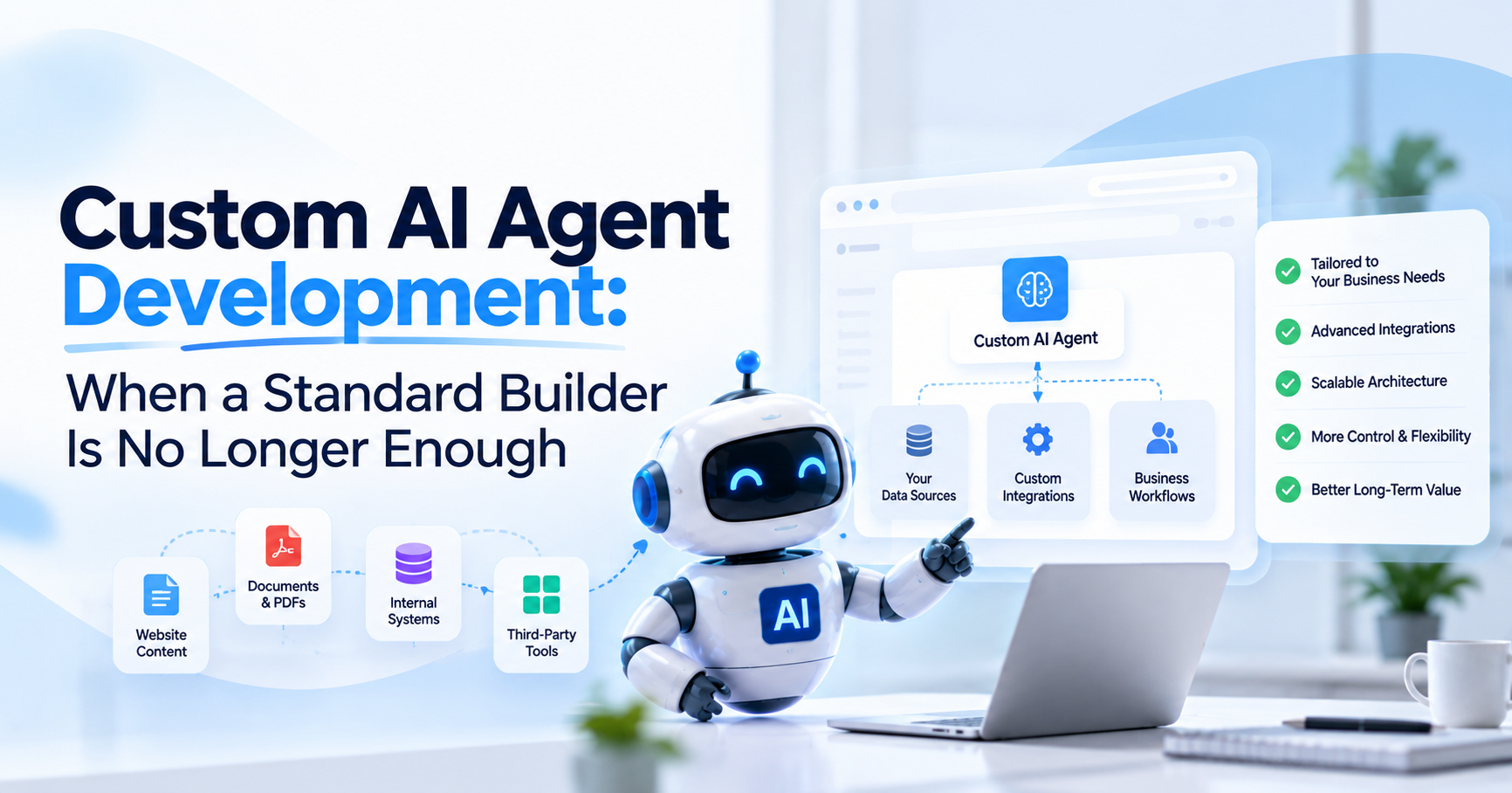
A standard AI agent builder can handle far more in 2026 than it could a few years ago.
Businesses can use ready-made platforms to learn from websites, upload company knowledge, answer customer questions, capture leads, hand conversations to people, connect common applications, and deploy an AI assistant without developing the entire system from scratch.
That is enough for many business websites.
The case for custom AI agent development begins when the important part of the project is no longer the chat interface or basic knowledge base. It begins when the AI must behave according to workflows unique to your company, access proprietary systems, enforce complex permissions, operate inside your own software, perform sensitive actions, or meet infrastructure and governance requirements that a standard builder cannot support reliably.
That distinction matters because custom development creates both freedom and responsibility.
You gain more control over architecture, workflows, integrations, interfaces, data, permissions, deployment, and ownership. You also take on more development, testing, security, monitoring, maintenance, and operating cost.
The right question is therefore not: “Would a custom AI agent be more powerful?”
It probably could be. The useful question is: “Which requirement do we have that a standard platform cannot handle reliably enough?”
If you cannot identify that requirement clearly, you may not need custom development yet.
What Is Custom AI Agent Development?
Custom AI agent development means designing an AI-powered application around the specific systems, workflows, permissions, users, and business rules of an organization instead of relying entirely on the standard functionality of an existing AI agent builder.
A custom agent can still use managed AI models, cloud infrastructure, vector databases, authentication providers, APIs, and third-party services. Custom does not mean every technical component must be created from zero.
What becomes custom is the application architecture and behavior.
For example, imagine a SaaS company wants an agent that appears inside its product. The agent must recognize the logged-in customer, understand the customer's subscription, check feature permissions, search technical documentation, inspect account configuration, perform approved changes, create support issues, update CRM records, and maintain an audit trail.
That is not simply a website chatbot with extra FAQs. The AI is becoming part of the company's software product and operating workflow. Modern enterprise platforms reflect this spectrum. Microsoft Foundry, for example, now supports both managed prompt agents and hosted agents built with custom code.
That illustrates an important point: choosing custom development does not necessarily mean abandoning managed infrastructure. A business can customize the components that make its workflow unique while continuing to use managed services for models, tools, identity, hosting, or observability.
When Is a Standard AI Agent Builder Still Enough?
A standard builder is usually enough when the main requirement is to make existing business information easier for customers to access and connect that conversation with common sales or support workflows.
Suppose a service business wants visitors to ask about services, pricing, locations, policies, project requirements, and availability for a consultation. It also wants to collect leads and transfer important conversations to staff.
A managed platform can often support that without a custom software project.
The same applies to many ecommerce, SaaS, real estate, education, travel, and small-business websites where the initial requirement is website Q&A, product or service guidance, customer support, lead capture, document knowledge, multilingual conversations, analytics, and human handoff.
Agent Best AI follows this managed website-first model. Its current workflow starts with website knowledge, supports additional business documents, deploys through a website widget, and can extend into API or custom integration requirements where necessary. September Month Blogs For Agent…
For this type of project, paying developers to recreate crawling, knowledge management, the chat interface, conversation storage, basic analytics, handoff, and deployment may add cost without solving a business requirement that actually needs custom engineering.
If you are still deciding between these approaches, the previous guide on custom AI chatbot development vs a no-code builder covers the broader comparison.
Custom Development Makes Sense When the Workflow Is Proprietary
The first major reason to choose custom AI agent development is that the workflow itself belongs uniquely to your business.
A standard builder works best when your process resembles common patterns such as answering FAQs, capturing leads, booking meetings, creating support tickets, or retrieving straightforward business data.
Custom development becomes easier to justify when the agent has to apply rules that only exist inside your organization. Consider a logistics company receiving a shipment-change request.
The agent may need to identify the customer, retrieve the shipment, check contract conditions, inspect customs status, determine whether rerouting is allowed, calculate additional charges, request manager approval above a threshold, update the internal logistics system, and notify operations.
The complexity does not come from having a conversation. It comes from orchestrating a company-specific business process.
Trying to force a deeply proprietary workflow into a generic visual builder can eventually become harder to maintain than writing the correct application logic.
In that situation, custom engineering allows the business rules to remain explicit, testable, version-controlled, and integrated with the systems already responsible for the operation.
Custom Development Makes Sense When Internal Systems Are Not Standard SaaS Tools
The second threshold appears when the agent needs systems that a standard platform cannot reach through normal integrations.
A builder may already connect with common CRMs, ecommerce platforms, help desks, calendars, communication tools, and automation services. That is useful because many businesses use the same applications.
But your company may rely on a warehouse application built fifteen years ago, an internal pricing engine, a proprietary order-management system, a private database, or an industry-specific platform with unusual authentication.
If the AI agent must use those systems, a custom connection may be unavoidable. This does not always mean building the whole agent from scratch. You may only need one custom integration.
Amazon Bedrock AgentCore, for example, provides a gateway architecture for exposing existing REST APIs and functions to agents as controlled tools, with separate inbound and outbound authorization.
The architectural lesson applies regardless of platform: existing business services can often remain where they are while a controlled integration layer exposes only the capabilities the agent needs.
That is frequently better than redesigning the business around the limitations of the chatbot software. For a deeper look at the integration layer, see the guide to chatbot integration services.
Custom Development Makes Sense When Identity and Permissions Are Complex
A custom system becomes much more useful when different users should see or do different things. Imagine an internal AI assistant used by employees.
A support agent may access customer tickets.
A salesperson may access CRM opportunities.
A finance employee may access invoice information.
A manager may approve certain actions.
The AI should not receive one credential that gives every user access to everything. The same issue applies to customer-facing applications.
A user on the Starter plan may have access to different features from an Enterprise user. A company administrator may be able to change account settings that an ordinary employee cannot. A support agent may retrieve information but not modify billing.
Once these rules become central to the product, authentication and authorization are no longer secondary integrations. They become part of the application architecture.
Custom development allows the AI experience to work with the organization's existing identity, role, permission, and policy model rather than forcing a simplified permission structure around the limitations of an off-the-shelf chatbot.
This is especially important when the agent can perform actions.
OWASP identifies excessive functionality, excessive permissions, and excessive autonomy as major causes of excessive-agency risk in LLM applications. A custom implementation can expose narrow functions instead of handing the AI broad access to a system simply because that access is technically available.
Custom Development Makes Sense When the AI Is Part of Your Product
Embedding AI deeply inside your own software is one of the clearest cases for custom work. There is an important difference between placing an AI widget on your marketing website and building AI into the normal product experience. A SaaS company may want customers to open the AI assistant from inside its application and ask:
“Why did revenue decline last month?”
“Which customers are at risk?”
“Create a report for this account.”
“Change this configuration.”
“Show me the orders affected by this issue.”
Now the AI needs awareness of the application's state, customer identity, data model, interface, permissions, and product-specific actions. A generic floating widget may no longer provide the right user experience.
The AI could need to appear inside specific pages, respond to what the user is currently viewing, trigger product functions, render structured results, or communicate with several backend services.
That is where chatbot application development services become materially different from basic website chatbot deployment. The agent is no longer an accessory added to the product. It is becoming a product feature.
If this describes your project, the existing comparison of chatbot application development services vs SaaS platforms provides additional context.
Custom Development Makes Sense When the Agent Performs High-Impact Actions
A standard knowledge agent can answer: “What is your cancellation policy?”
A connected agent may answer: “What subscription am I currently using?”
An action-taking agent may receive: “Cancel my subscription.”
These are three different levels of responsibility. The first uses business knowledge. The second needs authenticated data. The third changes a real business system.
The more consequential the action, the stronger the case becomes for precise application logic around authorization, validation, confirmation, logging, limits, and human approval.
A custom financial-service agent, for example, may require different approval paths based on transaction value.
A customer-service agent may be allowed to issue a small credit automatically but require an employee to approve anything above a fixed threshold.
A logistics agent may prepare a rerouting request but leave the final approval to operations.
A healthcare or regulated workflow may have additional controls that cannot simply be represented as one unrestricted API tool.
Microsoft's current tool-security guidance recommends validating tool outputs, limiting data sent to tools, protecting credentials outside prompts, and requiring user approval before consequential actions. Those controls become easier to enforce when your architecture can explicitly define what the agent is permitted to do.
Custom development should not be used to give AI more authority. It should be used when you need finer control over that authority.
Custom Development Makes Sense When Your Knowledge Architecture Is Unusually Complex
Website pages and uploaded documents are enough for many agents. They are not enough for every organization.
A large enterprise may need the agent to answer from several knowledge systems while respecting department, region, customer, product, and security boundaries.
Some knowledge may be public.
Some may be available only to employees.
Some may be restricted to one customer account.
Some may come from structured databases.
Some may need near real-time retrieval.
Some sources may have strict precedence rules when information conflicts.
Now knowledge retrieval becomes an application architecture problem rather than simply an upload feature.
You may need custom indexing, metadata, filtering, tenant isolation, retrieval rules, hybrid search, data synchronization, source permissions, or domain-specific ranking.
That does not automatically mean training your own model. It usually means designing a more specialized knowledge layer around an existing model.
For businesses with straightforward website and document knowledge, a managed system is still likely to be more practical. The existing Agent Best AI guide on how to make an AI chatbot agent know your business explains the simpler knowledge-grounding approach.
Custom Development Makes Sense When One Agent Needs Several Specialized Tools
A standard website assistant may only need knowledge and a human-handoff mechanism. A more advanced agent may need separate tools for account lookup, CRM search, inventory, invoicing, scheduling, ticket creation, document search, and business actions.
At that point, tool architecture matters.
OWASP's 2025 Sensitive Information Disclosure guidance specifically identifies personal information, financial details, health records, confidential business data, credentials, and legal documents as types of information that can create disclosure risks in LLM applications.
Modern agent platforms increasingly support custom functions, OpenAPI tools, MCP servers, and reusable tool layers. Microsoft Foundry currently allows custom tools alongside managed tools, while its tooling model centralizes authentication, governance, and versioning.
That does not mean every multi-tool agent requires a completely custom application. It means the likelihood of custom engineering increases as tool orchestration becomes specific to your business rather than a straightforward connector workflow.
Custom Development Makes Sense When You Need Deterministic Business Logic Around AI
Not every decision should be delegated to a language model. Suppose an agent handles account upgrades.
AI can understand what the customer is asking.
AI can explain the available plans.
AI can collect the required information.
But whether a particular account is legally or financially eligible for a specific change may need deterministic rules. A robust custom application can separate these responsibilities. The language model handles natural-language interpretation.
A retrieval system supplies business information.
Conventional software validates the request.
A permissions service determines authority.
A rules engine applies non-negotiable business conditions.
A transactional API performs the action.
The AI then explains the result.
This architecture is often stronger than asking the model to “reason” through rules that should simply be enforced by code. Custom development becomes particularly valuable when these deterministic components are unique to your business and need to operate alongside the conversational layer.
Custom Development Makes Sense When You Need Complete Control Over Deployment
Some organizations have infrastructure requirements that make ordinary SaaS deployment unsuitable. The agent may need to operate within a particular cloud environment, virtual network, region, authentication architecture, data boundary, or observability stack.
You may need separate development, staging, and production environments.
You may need deployment approval processes.
You may need private connectivity to internal systems.
You may need specific logging, monitoring, backup, disaster-recovery, or operational controls.
At this level, the question is no longer simply whether a builder has the features you need. The infrastructure itself becomes part of the requirement.
NIST's AI Risk Management Framework takes a lifecycle view of AI risk, covering design, development, deployment, use, and evaluation rather than treating risk management as a final launch task. That principle is especially relevant when the agent becomes part of business-critical infrastructure.
Custom Development Makes Sense When You Need Better Observability Than a Standard Dashboard Provides
If an AI agent becomes operationally important, you may need to understand far more than total conversations and user ratings.
A production engineering team may need to inspect which model was called, which knowledge was retrieved, which tools were invoked, what arguments were sent, what response came back, how long each stage took, where the error occurred, and what the agent decided next.
That is observability.
Amazon Bedrock AgentCore's current observability tooling, for example, supports traces across agent workflows as well as metrics such as latency, duration, token usage, and error rates.
This level of detail becomes valuable when the AI agent is supporting important business workflows. Suppose customers suddenly report that order changes are failing.
A basic analytics dashboard may show more unresolved conversations. A proper trace may show that the underlying order API started returning a new error after an update. When agent reliability matters operationally, custom telemetry and monitoring may justify additional engineering.
Custom Development Makes Sense When Ownership and Portability Matter Strategically
If the AI agent is becoming strategic intellectual property, control over the application can be a legitimate reason to invest in custom development.
That might include control over source code, repositories, infrastructure, deployment pipelines, prompts and instructions, knowledge architecture, integrations, evaluation datasets, data pipelines, observability, and documentation.
But do not confuse “custom” with “owned.” Ownership depends on the development contract and technical setup.
A business can pay for a custom application and still end up dependent on an agency's cloud account, proprietary libraries, undocumented infrastructure, or individual developers. If portability matters, design for it.
Your own organization should know how the application is deployed, what external services it depends on, which credentials are required, how data is stored, how a new version is released, and how another qualified team could take over maintenance.
The previous guide on choosing an AI agent development company goes deeper into ownership, documentation, maintenance, testing, and vendor dependency.
When Does Custom AI Chatbot Development Become Overengineering?
Custom development becomes overengineering when you are rebuilding standard functionality without a business requirement that benefits from the extra control.
Suppose a small consulting firm wants visitors to ask about its services, pricing, industries, FAQs, and consultation process.
It wants the chatbot to collect a prospect's contact information and transfer important enquiries to its team. A standard platform can already handle much of that.
Creating a custom crawler, retrieval pipeline, model layer, widget, conversation database, dashboard, lead-capture workflow, analytics system, and handoff interface may technically be possible.
But what business problem did all that engineering solve?
The custom system may cost more to build, require more maintenance, introduce more failure points, and take longer to improve without producing a materially better customer experience.
The fact that something can be custom-built is not sufficient justification for building it.
When Does a Standard Builder Become the Bottleneck?
A builder becomes the bottleneck when important customer or operational outcomes cannot be implemented reliably because of the platform's structural limitations. That is the threshold to watch.
If the problem is cosmetic, such as wanting slightly different widget styling, custom application development may be excessive.
If the problem is operational, such as being unable to authenticate users correctly, access a proprietary system, enforce business permissions, embed the assistant inside the product, or execute a critical workflow safely, the argument for custom work becomes much stronger.
The distinction is important. Custom development should remove a meaningful constraint. It should not simply give the project more technology.
Standard Builder, Hybrid Architecture, or Fully Custom?
For many businesses, the most effective architecture sits between an off-the-shelf builder and a completely custom application. Consider an ecommerce company.
Its agent needs to answer product questions, explain shipping, provide return information, guide shoppers, and transfer difficult conversations.
A managed platform can handle much of this. Later, the business decides it needs authenticated order lookup from a proprietary fulfillment system.
Instead of rebuilding everything, it can keep the existing knowledge, chat interface, analytics, and handoff while developing the custom API integration required for order information. Now imagine the requirement grows further.
The agent must modify orders, calculate loyalty exceptions using private rules, interact with a warehouse platform, enforce customer-specific permissions, obtain approval for certain changes, and maintain a detailed audit trail.
At that point, more of the system may reasonably move into custom architecture. This gradual approach prevents a business from paying for the final hypothetical architecture before real usage proves it is necessary.
Why the Hybrid Approach Is Becoming More Practical
The boundary between SaaS and custom development is becoming less rigid. A company no longer has to choose between configuring an entirely closed platform and building every technical component from scratch.
Managed agent runtimes can host custom code.
API gateways can expose proprietary tools.
Managed identity can handle authentication.
Existing model providers can supply the language model.
Observability platforms can trace execution.
An existing chatbot product can supply the website layer while custom services handle proprietary workflows. This changes the economics of AI chatbot development services.
The strongest architecture may not be “custom everything.” It may be: Managed infrastructure for common capabilities, custom engineering for competitive or operationally unique capabilities.
That is often the most maintainable interpretation of custom AI agent development in 2026.
What Does a Hybrid AI Agent Architecture Look Like?
A hybrid architecture keeps solved problems inside established software and develops only what the business uniquely needs.
For example, Agent Best AI can provide the website-facing layer for knowledge, conversations, deployment, human handoff, analytics, and standard integrations. Its current product structure also includes API access and custom integration assistance for workflows that need to extend beyond the standard setup. September Month Blogs For Agent…
A business with one proprietary application could therefore keep the common agent infrastructure and develop a narrow service that exposes the required internal capability through a controlled API.
That avoids paying to recreate the entire customer-facing AI platform. The same principle works in the opposite direction.
A company building AI directly into its software might develop its own product interface and business orchestration while relying on managed model, identity, search, hosting, or monitoring services underneath. Custom architecture should be selective.
How Do Chatbot Integration Services Fit Into Custom Development?
Chatbot integration services connect the AI layer with the systems that contain live data or carry out business workflows, and they often represent the first stage between a standard agent and a fully custom application.
A business may not need a custom chatbot. It may simply need a custom integration.
For example, the existing platform already handles website knowledge and customer conversations, but the business needs the AI to check information in an internal ERP.
Developing that one integration is very different from building the complete chatbot application. This is why businesses should separate three decisions.
First, what conversation experience do you need?
Second, what information must the AI retrieve?
Third, what actions must it perform?
The more existing platforms can handle the first requirement, the more custom development can remain focused on the second and third. That usually results in less code and fewer components to maintain.
How Does Product Embedding Change the Decision?
Product embedding strengthens the case for custom development because the AI becomes part of the normal application state rather than a separate conversation widget.
Imagine an analytics application. A user is viewing a revenue dashboard and opens the AI assistant.
They ask: “Why did this number fall?”
The best experience may require the AI to understand which account is open, which date range is selected, what filters are active, what permissions the user has, and which underlying dataset produced the metric.
Now imagine the user asks: “Create a segment of the customers responsible for most of this decline.”
The agent may need to call product functions and return a result directly inside the existing interface.
This requires much tighter integration between frontend state, backend services, permissions, AI tools, and application logic than a standard website chatbot.
When AI is a core product feature, chatbot application development services or broader agent application development can be a legitimate software investment.
How Do Complex Permissions Change the Decision?
Complex permissions strengthen the need for custom engineering because authorization must remain consistent with the rest of the application. Suppose a company has regional sales teams.
A salesperson in London can view UK accounts.
A manager can see the full region.
A global administrator can see everything.
The AI agent should not retrieve records merely because the model correctly understands the user's request. The backend still needs to enforce those access rules.
This should remain true even if the model is manipulated, misunderstands an instruction, or calls the wrong tool.
A secure architecture should therefore treat the language model as one component operating inside a permissions system, not as the permission system itself.
That distinction becomes increasingly important as agents move from answering questions to taking actions.
How Do High-Risk Actions Change the Decision?
High-risk actions increase the value of custom controls because the cost of an incorrect action is larger.
Consider the difference between: “Explain our refund policy.”
And: “Issue a $4,000 refund.”
The second workflow may require authenticated identity, order verification, eligibility rules, fraud checks, approval thresholds, explicit user confirmation, audit logging, and possibly human authorization.
A standard platform might technically support calling the refund API. That does not automatically mean the surrounding safeguards meet your business requirements.
If consequential actions are central to the use case, evaluate the full control path rather than simply checking whether the builder supports APIs. The goal should be bounded agency. Give the AI the smallest set of actions and permissions needed to complete the legitimate task.
What Determines AI Chatbot Development Cost Once You Go Custom?
AI chatbot development cost rises primarily with architecture and operational complexity, not simply with how many chatbot messages the system can send. A public knowledge assistant is comparatively straightforward.
Add authenticated users and the project needs identity.
Add private account data and it needs secure data access.
Add proprietary systems and it needs integrations.
Add write actions and it needs authorization, validation, and failure handling.
Add business-critical operation and it needs stronger testing, monitoring, incident handling, and deployment controls.
Add product embedding and you now have frontend and backend application work.
Add multi-tenancy and you need tenant separation.
Add specialized governance and the project gains another operational layer.
This is why two projects both called an “AI chatbot” can have completely different budgets.
Rather than repeating cost ranges here, the detailed guide to AI chatbot development cost explains how knowledge systems, integrations, authentication, infrastructure, testing, hosting, maintenance, and custom workflows affect total cost.
The useful budgeting question is: “What custom requirement are we paying engineering to solve?”
If the answer is unclear, refine the scope before asking for estimates.
Should You Use Custom AI Chatbot Development Services or a Managed Platform?
Use custom AI chatbot development services when the important parts of your system are specific to your business and cannot be represented reliably inside the standard platform.
Use a managed platform when the important parts are already standard capabilities. A company needing a customer-facing assistant trained on website pages and documents is usually solving a common problem.
A company needing an embedded agent that understands authenticated users, calls proprietary services, follows unique decision rules, performs controlled actions, and writes back into several internal systems is solving a custom software problem.
There is no advantage in pretending those projects are equivalent. If you want a deeper breakdown of what development teams actually build, see AI chatbot development services.
What Should You Define Before Starting Custom Development?
Before commissioning custom development, you should be able to describe the system in terms of knowledge, systems, identity, permissions, actions, handoff, deployment, monitoring, and ownership.
You should know what information the agent needs.
You should know which systems contain that information.
You should know who the users are.
You should know what each user may access.
You should know which actions the agent can take.
You should know what requires human approval.
You should know what happens when an API fails.
You should know how the agent's behavior will be tested.
You should know how production failures will be investigated.
And you should know who owns and maintains the resulting application.
If these questions are still unresolved, custom development may begin too early. The architecture checklist in Build Your Own AI Agent can help define those requirements before development starts.
Where Agent Best AI Fits
Agent Best AI is designed for businesses that want to avoid custom development where the standard problem is already solved.
The platform can start from an existing website, build knowledge from relevant business content, incorporate additional documents, deploy a website agent, support customer questions and lead conversations, provide human handoff, and extend into integrations when needed. September Month Blogs For Agent…
That makes it a practical starting point when the requirement is: “We need an AI agent for our business website.”
rather than: “We need to build a proprietary AI application.”
The distinction becomes clearer after the first version is running. If customers mainly need product, service, pricing, policy, support, or FAQ information, the managed platform may continue to be enough.
If real usage reveals a need to access a proprietary internal application, perform unusual authenticated actions, or support a workflow outside the standard integration model, API or custom development can be introduced specifically for that requirement.
You can review how Agent Best AI works, explore its AI agent features and integrations, or contact Agent Best AI to assess whether your requirement can be handled through the standard platform before commissioning a larger custom build.
Final Thoughts
Custom AI agent development becomes worthwhile when customization solves a meaningful business constraint.
Proprietary workflows are a reason.
Legacy or internal systems can be a reason.
Complex authentication and permissions can be a reason.
Deep product embedding can be a reason.
High-impact actions can be a reason.
Specialized knowledge architecture, infrastructure, observability, governance, or ownership requirements can also justify custom work. Wanting a chatbot that answers questions from your website is usually not enough by itself.
The strongest approach is to separate what is standard from what is genuinely unique.
Use managed software for capabilities that are already solved well.
Use integrations when only the connection is custom.
Use a hybrid architecture when most of the system is standard but a few workflows are proprietary.
Move to deeper custom development when the AI becomes part of your product, internal operations, or business-critical application architecture. That approach keeps the amount of custom code proportional to the value custom engineering actually creates.