What Is AI Customer Support?
AI customer support is the use of artificial intelligence to help businesses manage customer questions and support processes.
It can operate through website chatbots, help centers, email, messaging platforms, support desks and internal tools. Depending on the system, AI may communicate directly with customers or work behind the scenes to help support representatives respond faster.
AI customer-support tools can understand natural language, search business knowledge, identify customer intent, recommend responses, summarize conversations and route cases to the appropriate person.
A chatbot is therefore only one part of AI customer support. The wider system may also include ticket automation, agent assistance, workflow actions, analytics and knowledge management.
Why Businesses Are Automating Customer Support
Customers increasingly expect fast assistance, even outside normal working hours. Zendesk’s 2026 research reports that 74% of consumers expect support to be available around the clock because of AI, while 88% expect faster responses than they did one year earlier. At the same time, support teams must manage rising conversation volumes without sacrificing service quality.
Automation provides a practical way to handle repeated and lower-risk requests immediately. Human representatives can then focus on complaints, unusual situations, important customers and issues that cannot be resolved through standard information.
Adoption is also growing quickly. Salesforce reported that the use of AI agents among customer-service organizations increased from 39% in 2025 to 66% in 2026. However, automation should begin with a real customer problem. Adding AI without clear knowledge, boundaries or human support can create faster answers that are still inaccurate or unhelpful.
How Businesses Use AI to Automate Support
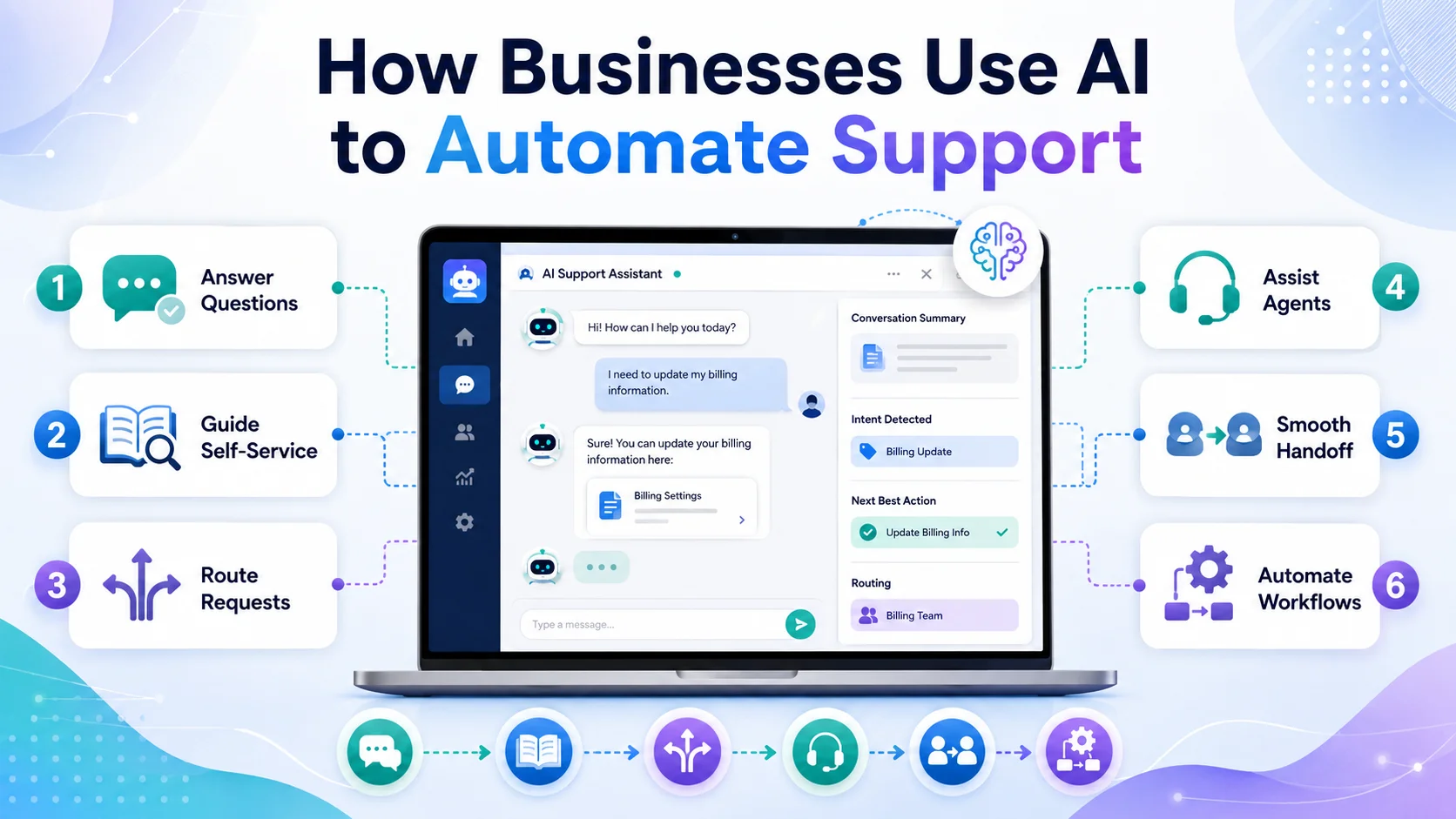
Answering Common Questions
The simplest use of AI customer support is answering repeated questions. Customers may ask about business hours, pricing, product features, shipping, returns, appointment procedures, account access or service availability. AI can retrieve answers from approved FAQs, policies, product information and support documents.
For example, instead of searching through a long returns page, a customer might ask: “Can I exchange an item purchased during a sale?” The AI can explain the company’s actual exchange conditions and direct the customer to the correct process. This works best when the business knowledge is accurate and regularly updated. AI should not create an answer when the information is unavailable.
Guiding Customers Through Self-Service
Many customers are willing to solve straightforward issues themselves when the process is clear. AI can guide them toward help articles, account instructions, troubleshooting steps, forms, policies or relevant website pages. Rather than presenting a large list of resources, it can identify what the customer is trying to do and recommend the most useful next step.
For example, a software user might ask how to invite a colleague to an account. The AI can provide the approved instructions or direct the user to the appropriate documentation. Self-service should remain optional. Customers must still have access to a person when the instructions do not resolve the issue.
Classifying and Routing Support Requests
Support teams often spend time reading new tickets and deciding who should handle them. AI can analyze an incoming message, identify its subject and urgency and route it to the right team. A billing question may go to accounts, a technical issue to product support and an enterprise enquiry to a senior representative.
The system may also identify whether a request is routine, urgent, sensitive or likely to require approval. This reduces manual sorting and can help important cases reach the appropriate person sooner.
Assisting Human Support Representatives
AI does not have to speak directly with the customer to improve service. It can support representatives by retrieving relevant knowledge, suggesting possible replies, summarizing long conversations and presenting useful customer information. IBM notes that AI tools can analyze messages and recommend replies, knowledge-base content or troubleshooting steps, reducing the time agents spend searching through documentation.
The representative remains responsible for reviewing the information and deciding how to respond. This is particularly useful for complicated cases where AI may not be trusted to make the final decision but can still reduce preparation time.
Summarizing Conversations for Human Handoff
Poor handoff is one of the most frustrating problems in automated customer service. A customer explains the issue to a chatbot, reaches a human and then has to repeat the entire story. Effective AI support should transfer the conversation history, information already collected, the original request and the reason for escalation.
IBM’s 2026 guidance emphasizes that human escalation should be designed into the process, with full context passed to the representative so the customer does not have to start again. A smooth transfer makes automation feel like part of one support experience rather than a separate barrier.
Automating Routine Support Workflows
When connected to approved business tools, AI may support actions beyond answering questions. Depending on the platform and permissions, it may help create a ticket, update a case status, collect return information, schedule an appointment, send a confirmation or trigger an internal notification.
Businesses must clearly distinguish between explaining an action and completing it. A chatbot may explain how to request a refund without being able to issue one. It should never claim to complete a task unless the required integration, permission and confirmation process are in place.
How AI Customer Support Helps Ecommerce Businesses
Ecommerce stores receive customer questions throughout the buying journey. Before purchase, shoppers may ask about product specifications, sizing, compatibility, availability, delivery, payment methods or return conditions. After purchase, they may need help with exchanges, damaged products, missing packages or order procedures.
AI customer support can make store information easier to access through conversation. For example, a shopper might ask: “Will this phone case fit the Pro version of the same model?” The AI can check the product information available in its knowledge base and provide an answer based on the published compatibility details.
It may also guide shoppers toward relevant products, collections, policies or support pages. Access to live inventory, individual orders or delivery tracking requires suitable integrations and secure customer verification. An ecommerce business should therefore be clear about what the AI knows and which actions still require a support representative.
Main Benefits of AI Support Automation
The first benefit is faster assistance. Customers can receive immediate answers to routine questions instead of waiting in a queue. Automation can also reduce repetitive work for support teams. Representatives have more time for technical problems, sensitive complaints, unusual requests and conversations where personal attention matters.
AI can improve consistency by using the same approved knowledge across conversations. It can also support customers during evenings, weekends and across different time zones. Conversation analysis provides another benefit. Repeated questions can reveal unclear website content, missing product information, confusing policies or weaknesses in the customer journey.
These features are not guaranteed. They depend on the quality of the information, system setup, integrations, testing and ongoing management.
What Should Not Be Fully Automated?
Some customer interactions should remain primarily human. These usually include:
Emotional complaints
Payment disputes
Unusual refund decisions
Sensitive personal information
Legal or regulated matters
Serious technical failures
Custom negotiations
Decisions requiring management approval
AI may collect initial information or identify the type of issue, but it should not make high-risk decisions without appropriate oversight. A customer should also be able to request human assistance directly. Automation should improve access to support rather than make a representative more difficult to reach.
How to Introduce AI Customer Support
Start by identifying a specific and repeated support problem. You might want to answer common policy questions, reduce basic tickets, support customers after working hours or provide faster access to product information. A focused first use case is easier to test than attempting to automate the entire support operation.
Next, prepare the information the AI will use. Review your FAQs, policies, product pages, service details, manuals and help articles. Remove anything outdated, duplicated or contradictory. Define clear boundaries. Decide what the AI may answer, what customer information it may collect and which situations must be transferred to a person.
Test the system with real customer language. Use incomplete sentences, spelling mistakes, frustrated messages, follow-up questions and issues that the AI should refuse or escalate. After launch, review conversations regularly. Update the knowledge whenever products, services, prices, policies or support procedures change.
How to Measure AI Customer Support
The number of automated conversations does not show whether customers are receiving good service. Businesses should measure outcomes such as:
First-response time
Successful resolution rate
Unresolved questions
Human-handoff rate
Repeat contacts
Customer satisfaction
Incorrect answers
Common support topics
Time saved for representatives
Quality of transferred conversations
A high automation rate can be misleading. If customers receive poor answers or cannot reach a person, more automation may actually reduce service quality. The aim should be effective resolution, not automation for its own sake.
Common Automation Mistakes
One common mistake is training AI on unreliable information. If policies, prices or product details are inconsistent, the system may repeat those inconsistencies to customers. Another mistake is attempting to automate complex situations too early. Businesses should begin with clear, repeatable questions before introducing actions involving accounts, payments or sensitive data.
Some companies also hide human-support options because they want the AI to handle more conversations. This often increases customer frustration and damages trust. Finally, AI customer support should not be installed and forgotten. It requires regular conversation reviews, knowledge updates, testing and adjustment.
How Agent Best AI Supports AI Customer Service
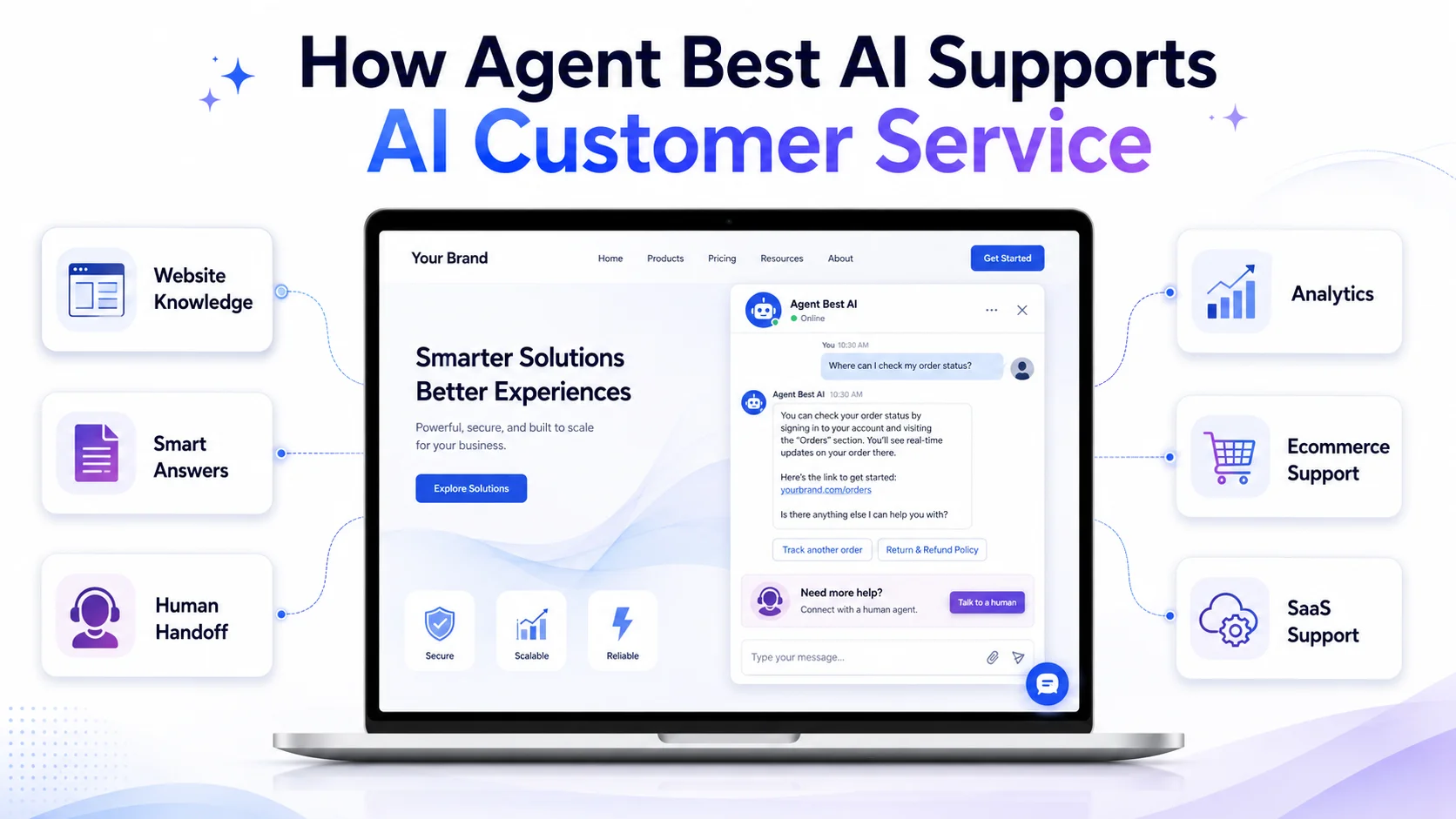
Agent Best AI helps businesses create an AI support agent using their existing website content and additional knowledge. The platform can learn from products, services, FAQs, policies, pricing information, manuals and uploaded support documents. After deployment through a website widget, it can answer routine questions, guide visitors, collect information and transfer complex conversations to a human team member.
AgentBest.ai also supports conversation analytics and allows businesses to update the agent’s knowledge as website information, policies or customer questions change.
For an ecommerce store, this may involve answering product, delivery and return questions. A SaaS company may use it for feature, pricing, onboarding and basic troubleshooting guidance. A service business may use it to explain processes and prepare enquiries for human follow-up.
Final Thoughts
AI customer support works best when automation and human service are designed together. AI can answer repeated questions, improve self-service organize support requests, assist representatives and provide help outside normal working hours. Human teams remain essential for situations involving empathy, exceptions, judgment and responsibility.
The strongest support strategy is not to automate every conversation. It is to automate the parts that are clear and repeatable, then make the transition to a person fast and easy when the customer needs more help.