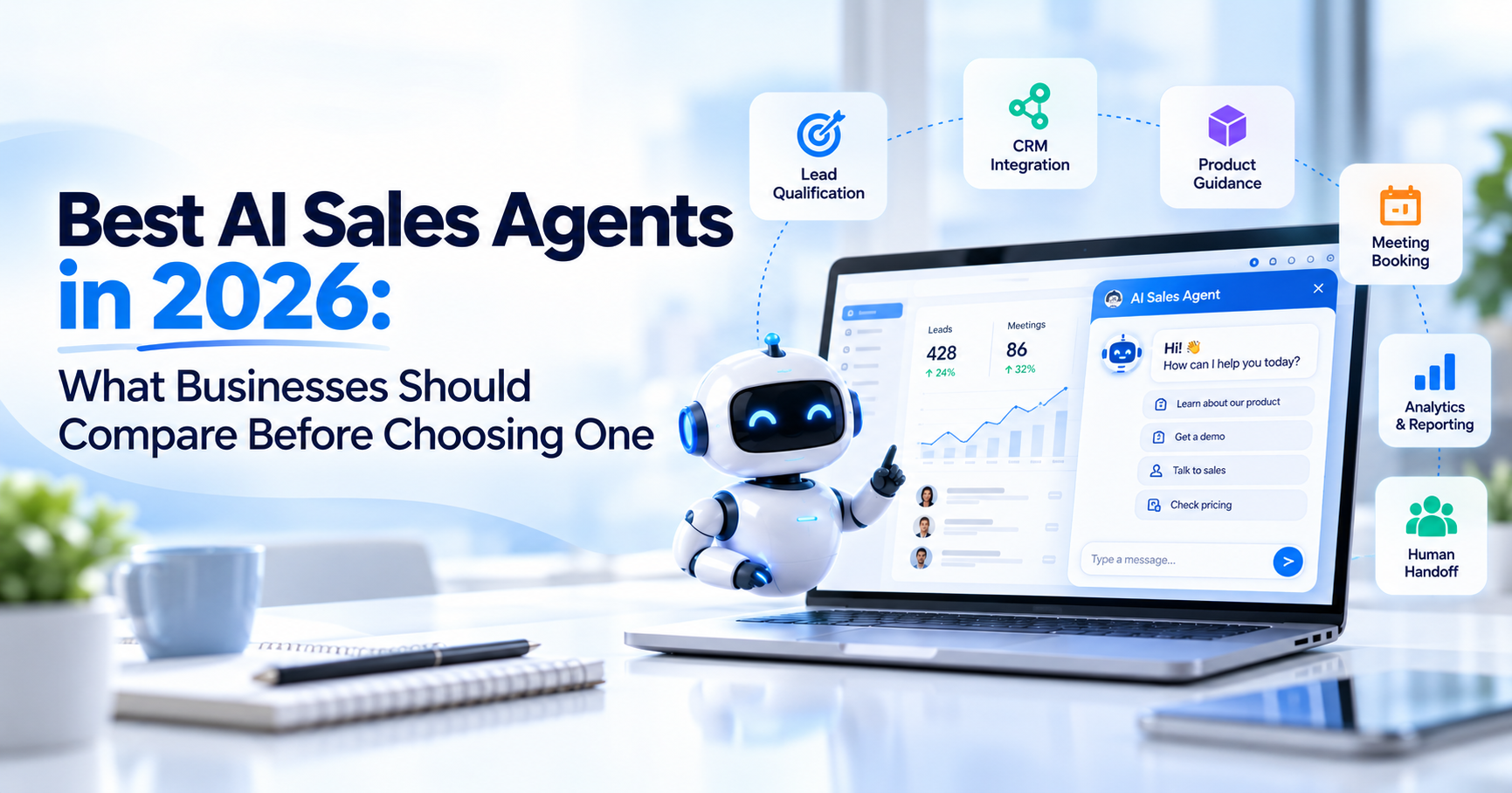
A website visitor rarely arrives thinking, “I want to talk to an AI sales agent.”
They arrive with a question. A shopper wants to know whether a jacket is available in the right size. A SaaS buyer wants to understand the difference between two plans. A prospective home buyer wants more information about a property. A service-business prospect wants to know whether the company can solve a particular problem.
What happens after that question determines whether conversational AI is useful.
A weak chatbot gives a generic answer and waits for another message. A well-designed AI sales agent can use real business information to answer the question, understand what the visitor is trying to accomplish, guide them toward a relevant product or service, collect useful information when buying intent appears, and move the conversation toward an appropriate next step.
That next step could be adding a product to a cart, booking a meeting, requesting a property viewing, submitting an enquiry, or transferring the visitor to a salesperson.
In 2026, however, products described as AI sales agents solve very different problems. Some are designed for B2B pipeline generation. Some specialize in ecommerce shopping conversations. Some combine CRM data with qualification and meeting booking. Others focus on turning an existing business website into an always-available source of product, service, and sales information.
This guide compares those approaches rather than pretending one platform is universally right for every company.
Disclosure: Agent Best AI is included because this article is published by Agent Best AI. The comparison is based on publicly documented capabilities available in October 2026, and the order is for readability rather than a claim that one platform is universally better than every other option.
What Is an AI Sales Agent?
An AI sales agent is a conversational system that helps move prospective customers through part of the buying journey using business knowledge, customer context, qualification rules, integrations, and defined sales actions.
For a website, that might begin with something simple: “Which plan includes API access?”
The agent uses product or pricing information to answer.
The visitor then asks: “Would that work for a team of 20?”
Now the conversation is becoming more specific.
If the visitor continues: “Can I see a demo?”
the AI agent may capture their details, qualify the opportunity, book a meeting, or transfer the conversation to sales depending on what the platform and integrations support.
That is different from an outbound AI SDR that primarily sends prospecting emails or performs cold outreach.
This article focuses mainly on AI agents for sales on business websites, because the search intent here is website Q&A, product and service guidance, inbound lead qualification, meeting or enquiry conversion, and human sales handoff.
What Should Businesses Compare Before Choosing an AI Sales Agent?
Businesses should compare how well the agent understands their own products or services, how it identifies buying intent, how qualification works, what sales actions it can perform, how it transfers conversations to people, and how deeply it connects with the systems already used by the sales team.
The chatbot interface itself is one of the least important differences. The real differences appear behind it.
An ecommerce business should care about catalog knowledge, sizing, product recommendations, shipping information, inventory context, carts, and post-purchase questions.
A SaaS company may care more about feature knowledge, pricing, lead qualification, CRM context, meeting booking, routing, and product documentation.
A real estate business may need property information, buyer or seller qualification, appointment requests, lead capture, and fast human follow-up.
A normal service business may simply need an AI sales agent for its website that can understand services, answer common questions, guide prospects, collect useful lead information, and hand serious enquiries to a person.
The correct comparison starts with the buying journey, not the AI feature list.
Best AI Sales Agents in 2026 at a Glance
| Platform | Best Suited For | Main Sales Strength |
|---|---|---|
| Agent Best AI | Business websites, ecommerce, SaaS, real estate, service businesses | Website-trained Q&A, product and service guidance, lead capture, human handoff, and website-first setup. Agent Best |
| Qualified Piper | B2B and SaaS teams focused on inbound pipeline | Website engagement, buyer qualification, routing, Salesforce context, and meeting booking. Qualified |
| HubSpot Customer Agent | Businesses already using HubSpot CRM | Website Q&A, CRM-connected qualification, lead scoring and routing, and meeting booking. Lead qualification was documented as beta in 2026. HubSpot Knowledge Base |
| Salesloft Drift | B2B conversational marketing and website conversion | Visitor identification, conversational qualification, recommendations, meeting booking, and live sales engagement. Salesloft |
| Gorgias AI Agent | Shopify ecommerce brands | Product recommendations, Shopify customer and order context, shopping assistance, post-purchase workflows, and human escalation. Gorgias |
| Tidio Lyro | Ecommerce stores wanting sales and support together | Product recommendations, Shopify and WooCommerce catalog connections, shopping guidance, support automation, and handoff. Tidio |
| Jotform AI Agents | Service businesses, real estate, appointments, and structured lead capture | Conversational qualification, forms, appointment scheduling, lead data collection, and website embedding. Jotform |
The important point is not which row contains the longest feature list. It is which approach matches what visitors need to accomplish on your website.
Agent Best AI: Website-First Sales Conversations
Agent Best AI fits businesses that already have useful sales information across their website and want to make that information easier for visitors to access through conversation.
The setup starts with the business website. The agent can learn from pages containing products, services, pricing, FAQs, policies, categories, and other customer-facing information.
Additional documents can be added when important sales or support knowledge is not available publicly. That makes the platform relevant for businesses where the sales problem begins with information friction.
A prospect may be interested but cannot work out which service applies to them.
A shopper may be unsure which product fits a particular requirement.
A SaaS buyer may not understand the difference between plans.
A real estate visitor may have questions before they are ready to submit a contact form.
In those situations, the conversation itself can become part of the sales journey. Agent Best AI can answer from the business's approved knowledge, guide visitors toward relevant products or services, collect lead information, and move complex or high-value conversations to the team.
You can review these capabilities on the Agent Best AI features page. It is particularly relevant when the business wants to introduce conversational sales without first building a complicated sales-agent infrastructure.
Qualified Piper: Built Around B2B Pipeline Generation
Qualified's Piper is much more explicitly focused on the B2B SDR role. Rather than acting primarily as a general website knowledge chatbot, Piper is designed around identifying, engaging, qualifying, and converting inbound buyers.
That includes real-time website conversations, sales meeting booking, routing, marketing offers, email engagement, and connections with go-to-market data.
Qualified is especially closely tied to Salesforce environments. The platform uses CRM information, account data, visitor behavior, intent signals, routing rules, and qualification criteria to determine how buyers should be handled.
That makes it particularly relevant to B2B companies where the website is already a major pipeline source and the sales process depends on account-level context.
A SaaS company that wants an AI agent to identify a target account, understand what the visitor is researching, qualify the buyer, route them to the correct account executive, and book a meeting has very different requirements from a small service company that mainly needs product and service Q&A. Piper is designed much closer to the first situation.
HubSpot Customer Agent: Strong When Sales Already Lives in HubSpot
HubSpot's Customer Agent has evolved beyond support-only conversations.
In its current 2026 implementation, businesses can configure lead-qualification criteria, allow the agent to ask qualifying questions, classify opportunities, update CRM lifecycle information, and route qualified prospects toward meeting booking.
This creates a major advantage for companies whose website, contact records, sales processes, lifecycle stages, meetings, and reporting already live inside HubSpot. Imagine a visitor asks about pricing.
The agent can answer using approved business content. If the conversation shows buying intent, it can begin qualification based on rules defined by the business. A qualified prospect can then be directed toward a meeting rather than simply leaving their email address and waiting for someone to respond later.
One detail businesses should note is that HubSpot's current lead-qualification functionality is documented as beta. That means the exact capability and availability should be checked in the account before building the sales process around it.
For HubSpot-centric teams, however, the attraction is clear: the website conversation can become part of the CRM workflow instead of remaining isolated inside a separate chatbot dashboard.
Salesloft Drift: Conversational Marketing for B2B Websites
Drift, now part of Salesloft's conversational marketing offering, is designed around converting website traffic into sales conversations.
Its current positioning focuses on recognizing valuable visitors, understanding intent, personalizing conversations using connected sales and marketing data, allowing visitors to ask open questions, making recommendations, qualifying prospects, booking meetings, and bringing salespeople into the conversation when appropriate.
This makes Drift particularly relevant for B2B companies where the website already attracts significant traffic from target accounts.
The sales value comes from reducing the distance between: “I am researching this company.” And: “I am speaking with the right sales representative.”
A normal contact form may collect the lead and create a delay. Conversational marketing tries to use the visitor's current intent while they are still actively evaluating the business.
That does not mean every visitor should immediately be pushed toward a meeting. Good qualification should also identify when someone needs information rather than sales contact.
Gorgias AI Agent: Ecommerce Sales and Support for Shopify
Gorgias is much more specialized. Its AI Agent is designed around ecommerce conversations, particularly for Shopify brands.
The agent can use product information, store website content, Shopify data, brand knowledge, customer context, and defined actions to support shoppers before and after purchase.
Its Shopping Assistant can recommend products using catalog information and signals from the shopper's current session. Gorgias also supports questions around products, shipping, returns, order changes, and other commerce workflows.
This is important because ecommerce sales conversations are often inseparable from customer-service questions.
A shopper may begin with: “Which shoes are suitable for wet trails?”
then ask: “Do you have size 10?”
Then: “How long would delivery take?”
Sales, product discovery, inventory, shipping, and support are part of the same decision. One limitation businesses should check carefully is platform support.
Gorgias currently documents full AI Agent support around Shopify, while support for other ecommerce platforms differs by feature. If your store is not on Shopify, verify the exact AI Agent capabilities before choosing it.
Tidio Lyro: Conversational Product Recommendations for Ecommerce
Tidio's Lyro is another strong ecommerce-oriented option, particularly when a business wants customer support and shopping assistance in the same environment.
Its current product-recommendation functionality can connect through Shopify, WooCommerce, a product feed, or an API. Lyro can ask follow-up questions, use available product information, recommend relevant options, and on Shopify allow customers to add products to the cart from the conversation.
That makes it particularly useful for stores where shoppers need help narrowing a catalog. Consider someone saying: “I need a black office chair under $300 for someone who sits eight hours a day.”
The value of conversational product discovery is that the visitor does not have to understand your category structure and filters before finding a relevant option.
Lyro can also move into support and human handoff, which matters because buying questions often turn into service questions during the same conversation.
Jotform AI Agents: Strong for Qualification and Appointment-Based Sales
Jotform AI Agents fit a different type of sales process. They are particularly useful when the goal of the website conversation is to collect structured information and move the prospect into a booking, consultation, application, quote, or appointment.
That makes them relevant for businesses such as real estate agencies, professional services, consultants, contractors, clinics, education providers, and appointment-based companies.
An agent can ask qualification questions conversationally, collect the information needed by the business, check availability, and schedule an appointment. This is particularly useful when a traditional contact form feels too rigid.
Instead of showing ten empty fields immediately, the agent can have a conversation first and gather information as it becomes relevant.
For real estate, for example, that might mean property type, preferred location, budget range, timeline, financing position, and preferred viewing time. The form is still collecting structured information behind the scenes, but the visitor experiences it as a conversation.
I Need an Ecommerce Chatbot That Can Suggest Products and Answer Shipping Questions. What Should I Use?
For ecommerce, use a platform that can combine real product knowledge with shipping and policy information, and choose a deeper ecommerce integration if you also need live inventory, carts, customer orders, or post-purchase actions.
For Shopify stores needing deep commerce context, Gorgias AI Agent and Tidio Lyro deserve consideration because both have dedicated ecommerce functionality. Gorgias is particularly Shopify-focused, while Tidio also documents product-recommendation connections for WooCommerce.
Agent Best AI is relevant when you want a website-first approach across ecommerce content. Its ecommerce AI chatbot can learn from products, categories, policies, shipping information, returns, FAQs, and additional knowledge to help shoppers search, compare, and understand products.
The deciding question is whether you need information or transactions. If the shopper asks: “Which backpack is suitable for a 16-inch laptop?”
the answer may come from product knowledge.
If they ask: “Is the blue one currently available?”
you may need live inventory.
If they ask: “Where is my order?”
you need authenticated order data.
Do not assume every ecommerce chatbot supports all three levels equally. For a deeper ecommerce comparison, the existing AI chatbot for ecommerce website guide explains how product knowledge, recommendations, policies, and live store data differ.
What Should I Use on a SaaS Website for a Chatbot That Can Book Demos and Answer Plan Questions?
For a SaaS website that needs both plan Q&A and automated demo booking, Qualified Piper or HubSpot Customer Agent are particularly relevant when meeting scheduling and CRM routing are central requirements, while Agent Best AI is useful when fast website knowledge and lead conversations are the priority.
The sales journey usually begins before the meeting request.
A buyer asks: “Does the Professional plan support SSO?”
Then: “Can our 25-person team use it?”
Then: “Do you integrate with our CRM?”
Only after receiving enough useful information do they ask for a demo. That means the AI agent needs strong product and pricing knowledge before it needs a calendar. Qualified Piper is built specifically around this inbound B2B journey and can qualify visitors and book appropriate sales meetings.
HubSpot's current Customer Agent can use business content for answers and, where the lead-qualification beta is available, classify prospects and route qualifying opportunities toward HubSpot meetings.
Agent Best AI's SaaS AI chatbot is more website-knowledge focused. It can explain features, answer pricing questions, support product discovery, capture leads, and hand the conversation to the team. If your sales process requires additional scheduling or CRM actions, evaluate the appropriate integration rather than assuming website knowledge alone can complete them.
The right option depends on whether your primary problem is explaining the product, qualifying inbound traffic, or automatically routing and scheduling sales conversations.
I'm Looking for a Chatbot for a Real Estate Website That Can Schedule Showings and Capture Buyer Leads. What Are Good Options?
For real estate, use an AI agent that can answer property questions and capture buyer requirements, then choose appointment-capable software when automatic viewing scheduling is essential.
A real estate lead usually needs more than a name and phone number. Useful qualification may include location, property type, budget, buying timeline, preferred viewing date, financing position, and specific property interest.
Jotform AI Agents are relevant when conversational qualification and actual appointment scheduling are central to the workflow.
Agent Best AI is suitable when the first priority is turning a content-rich property website into an interactive sales assistant. Its real estate AI chatbot is designed to answer property questions, collect buyer or seller information, and guide visitors toward listings, viewings, or consultations.
The distinction matters. Guiding someone toward a viewing can happen from website knowledge. Checking live calendar availability and confirming the appointment requires a scheduling system or integration. Choose based on which of those experiences your business actually needs.
How Can I Capture More Leads From People Who Visit My Website and Ask Questions?
The strongest approach is to answer the visitor's question first and collect lead information when the conversation reveals genuine intent. Asking every visitor for an email address before helping them often creates more friction.
Imagine someone asks: “Do you provide custom integrations?”
The AI explains what the business offers.
They continue: “We use a proprietary inventory platform. Could your system work with that?”
The AI explains what can be confirmed from the available knowledge and what would require further assessment.
Then the visitor says: “We are planning this for next quarter. Can someone discuss it with us?”
That is the natural moment for lead capture. The agent might collect a name, business email, company, relevant requirement, and preferred next step before sending the information to sales or transferring the conversation.
This gives the sales team context instead of another contact record containing nothing more than an email address.
Agent Best AI supports lead assistance and sales handoff as part of its business AI chatbot features, while platforms such as Qualified, HubSpot, and Jotform can go further into structured qualification and routing depending on the sales process.
How Do Businesses Improve Website Conversions With Conversational AI Tools?
Conversational AI can support conversion by reducing information friction at moments when a visitor is actively making a decision, but installing a chatbot does not automatically increase conversions. The first objective should be helping visitors continue the journey.
A prospect hesitating because they cannot find the pricing rules needs the pricing answer.
A shopper unsure about compatibility needs product information.
A SaaS buyer comparing plans needs the relevant differences.
A real estate prospect needs property information and a clear way to request a viewing.
When those questions are resolved quickly, the visitor has fewer reasons to abandon the process simply because information was difficult to find.
The second opportunity is guiding the next step.
The AI may point the visitor toward the correct product, service page, consultation, demo, cart, property listing, or human salesperson.
The third is learning from conversations.
If hundreds of visitors repeatedly ask a question that should be obvious from the website, the issue may not be the chatbot. The underlying website content may need improvement.
A good AI assistant for business therefore becomes both a conversion interface and a source of customer-intent data.
Do not measure success only by chatbot message volume. Look at meaningful outcomes such as qualified enquiries, meetings, product engagement, handoffs, and the customer questions that repeatedly block progress.
How Can I Add an AI Shopping Assistant to My Shopify Store to Answer Questions About Sizing and Returns?
For Shopify, connect an ecommerce-focused AI agent to accurate product data, size information, and current return policies, then test whether it can distinguish general store information from customer-specific order data.
Gorgias AI Agent is especially relevant when deep Shopify integration is important. Its AI can use Shopify product information and website content for product guidance, while its commerce workflows extend into post-purchase support.
Tidio Lyro is another option for Shopify product recommendations and customer conversations.
Agent Best AI can also support a website-first shopping experience using store products, categories, size guides, policies, FAQs, and other knowledge through its ecommerce chatbot solution.
For sizing, the quality of the product information matters.
If the store only says: “Available in S, M, L”
the AI does not have enough information to answer: “Which size fits a 40-inch chest?”
A good shopping assistant cannot compensate for missing size data. The same applies to returns. If sale-item rules differ from standard returns, make that distinction clear in the source policy before expecting the AI to answer reliably.
I Need an AI Lead Capture Widget for My Real Estate Website That Can Pre-Qualify Prospective Home Buyers. What Should I Use?
For conversational real estate qualification, Agent Best AI is suitable when property knowledge and website-based lead capture are central, while Jotform AI Agents are particularly relevant when you want a more structured qualification and scheduling workflow.
Start by deciding what “qualified” means for your agency. For one business, a qualified buyer may need a minimum budget. Another may care about pre-approval status. Another may focus on location, property type, timeline, or whether the visitor has a property to sell first.
The AI agent should collect information because it helps the next conversation, not because more fields always mean a better lead. A useful flow may begin with the property question. The visitor asks: “Is this apartment still suitable for a family of four?”
The agent answers from the listing information. Then the conversation reveals that the visitor is actively buying. Only then does the agent ask about location, budget, timeline, or viewing preference. This is more natural than opening the website with a large lead form before the visitor has received any help.
How Do I Deploy an Automated AI Assistant on a SaaS Landing Page to Explain Subscription Tiers and Feature Differences?
The simplest approach is to train the AI assistant on your current pricing, feature, FAQ, documentation, and policy content, test common comparison questions, and embed it through a website widget. Do not start by scripting every possible plan comparison manually.
A SaaS buyer may ask: “Which plan has API access?”
Then: “Does that include webhooks?”
Then: “What about SSO?”
Then: “We have 30 employees. Which tier is relevant?”
A properly trained website agent should retrieve the right information across those questions while keeping the conversation context. This is exactly why the knowledge layer matters before lead qualification.
If the sales agent cannot accurately explain the product, automating demo booking will only send confused buyers into more sales calls.
Agent Best AI's website-first setup begins by learning from the existing site and additional business knowledge before the agent is deployed through a widget.
The previous guide on how to make an AI chatbot agent know your business goes deeper into building reliable product and service knowledge before sales automation is added.
Product and Service Guidance Should Come Before the Pitch
An effective AI sales agent should help the visitor make sense of the available options before pushing for contact details. This is especially important on websites with several products, services, plans, or packages.
Suppose a visitor says: “We are a ten-person company and mainly need help answering customer questions after business hours.”
A generic sales bot might immediately respond: “Would you like to book a demo?”
A better agent first identifies the relevant product or service, explains why it may fit, answers the next question, and then offers an appropriate action when the visitor is ready.
That approach is closer to how a useful salesperson behaves. Good sales conversations reduce uncertainty. They do not simply accelerate form completion.
Lead Qualification Should Use Real Buying Criteria
Lead qualification should reflect the business's actual sales process. An enterprise SaaS company may qualify using company size, industry, use case, existing technology, timeline, and geographic region.
A service company may care about project type, approximate scope, location, budget range, and urgency. A real estate business might use property type, budget, area, timeline, and financing status.
The agent should not ask every possible question. Each question creates friction. Collect the minimum information required to make the next step better.
This is an area where CRM-connected tools such as Qualified and HubSpot can be particularly powerful because qualification can be tied directly to existing sales data and routing rules.
A simpler website agent may use conversational lead capture and transfer the context to a human team. Both approaches can work. They solve different sales processes.
Human Handoff Still Matters in AI Sales
AI sales agents should not be designed to keep humans out of every conversation. They should recognize when human involvement becomes more valuable. A high-intent enterprise buyer may want technical clarification that the AI should not improvise.
A real estate buyer may want to negotiate.
A shopper may have an unusual requirement.
A prospect may simply say: “Can I speak to someone?”
At that point, forcing another five automated questions can damage the experience. The sales handoff should preserve what has already happened.
The salesperson should know what the visitor asked, which product or service they discussed, what information was collected, and why the conversation was escalated.
That context is what turns an AI conversation into a useful sales handoff rather than another disconnected lead notification.
Integrations Determine What Happens After the Conversation
The chatbot can capture a lead perfectly and still create little value if the information never reaches the sales workflow. This is why AI sales agents should be evaluated on integrations as well as conversation quality.
A basic website setup may only need the chatbot dashboard and email notification.
A growing B2B company may need CRM creation, owner assignment, meeting scheduling, and sales alerts.
An ecommerce store may need product, cart, inventory, and order integrations.
A real estate company may need a CRM and appointment calendar.
The existing Agent Best AI guide to chatbot integration services explains how website deployment, knowledge, APIs, workflow automation, permissions, and human handoff fit together. The correct integration architecture is the smallest one that completes the real sales journey reliably.
Which AI Sales Agent Should You Choose?
Choose based on the sales motion you already have or genuinely want to build.
If your website contains substantial products, services, FAQs, policies, pricing, or business information and the main challenge is helping visitors get answers and become leads, Agent Best AI offers a straightforward website-first approach.
If you run a B2B sales organization focused heavily on inbound pipeline, account identification, Salesforce data, qualification, routing, and meeting booking, Qualified Piper addresses that more specialized workflow.
If your sales organization already operates in HubSpot and you want website conversations to feed directly into CRM qualification and meeting workflows, HubSpot Customer Agent deserves consideration, with the current beta status of lead qualification kept in mind.
If conversational marketing and live B2B website engagement are central, Salesloft Drift remains relevant.
For Shopify ecommerce, Gorgias AI Agent is designed around conversational commerce and deep store context.
For ecommerce product recommendations across Shopify or WooCommerce, Tidio Lyro is another option to evaluate.
If sales conversations naturally lead to forms, consultations, appointments, or structured lead capture, Jotform AI Agents can fit that workflow well.
The right choice becomes much clearer once you stop asking: “Which AI sales agent has the most features?”
and start asking: “What should happen when one of our real buyers asks one of our real sales questions?”
Where Agent Best AI Fits
Agent Best AI is designed for businesses that want their existing website to become a more conversational sales channel.
Instead of beginning with a blank sales workflow, the platform starts with the information the company already has. Website pages, products, services, pricing, FAQs, policies, and additional documents can provide the knowledge the agent uses during customer conversations.
The agent can then help visitors understand options, answer pre-purchase questions, provide product or service guidance, capture relevant lead information, and transfer important conversations to the business when personal sales involvement is needed.
That structure makes it relevant to ecommerce, SaaS, real estate, service businesses, and other websites where customer questions appear before a purchase or enquiry.
You can review how Agent Best AI works, explore its sales and customer-service features, or review the available AI chatbot solutions by industry to see how the same website-first approach changes across different buying journeys.
Final Thoughts
The most useful AI sales agent is not the one that talks the most. It is the one that removes the right obstacle at the right moment.
For one visitor, that means explaining a product.
For another, it means comparing plans.
For another, it means answering a shipping question.
For another, it means collecting enough information for a salesperson to continue the conversation intelligently.
And for a high-intent buyer, it may mean getting out of the way and connecting them with a person. When comparing AI agents for sales, evaluate the complete journey from the first question to the next useful action.
Check whether the agent understands your actual business. Test whether recommendations are grounded in real product or service information. Define how qualification should work. Verify what integrations are needed. Make human handoff easy.
Then measure whether conversations are producing useful customer outcomes rather than simply increasing chat volume. That is what separates an AI chatbot sitting on a website from an AI sales agent that genuinely participates in the buying journey.