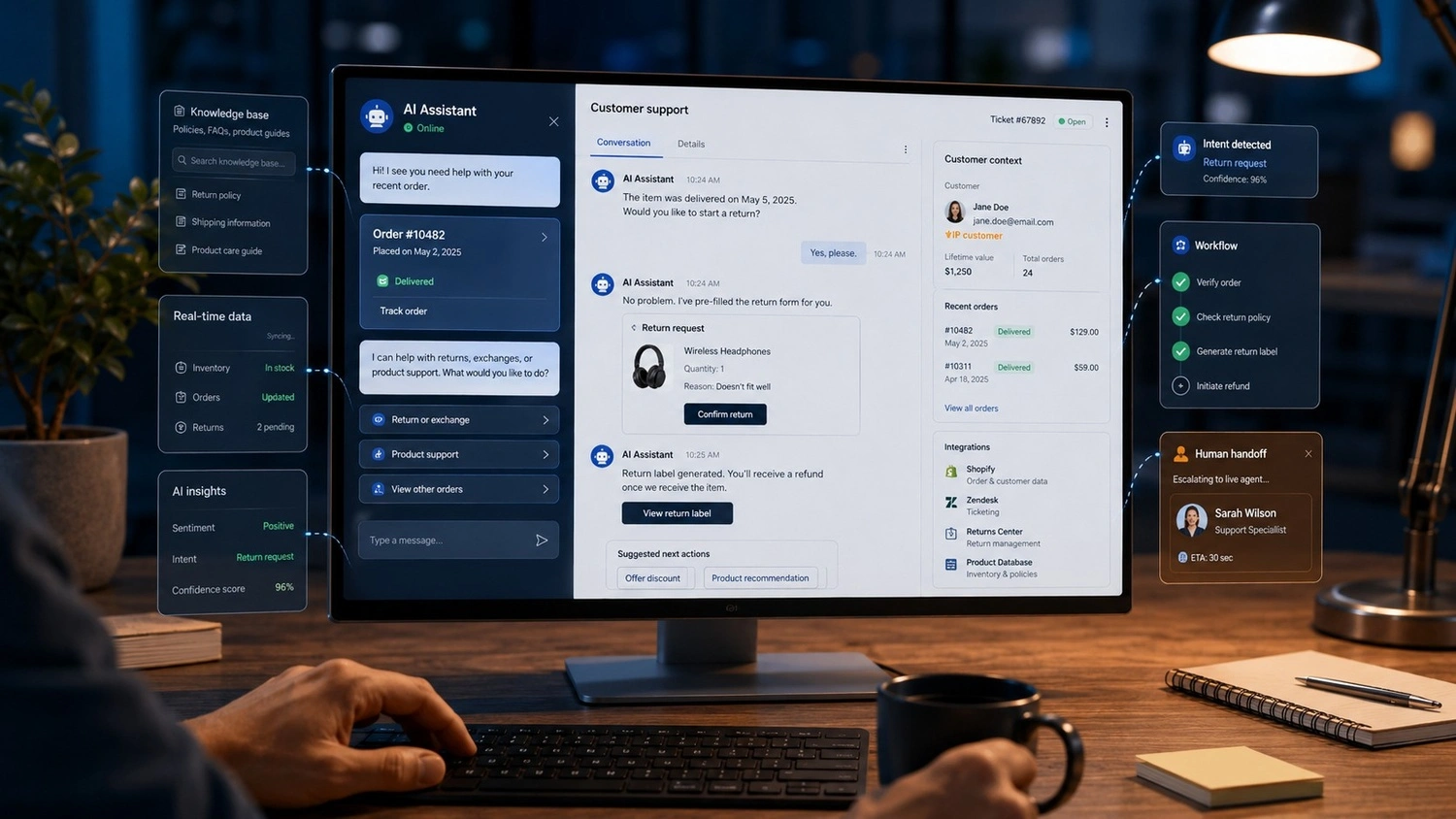
Instant Support at Any Time
E-commerce stores remain open around the clock, but customer service teams usually work limited hours. AI customer support helps close this gap by answering common questions 24/7.
Customers can receive immediate help with topics such as:
Shipping and delivery times
Return and refund policies
Product availability
Sizes, features, and compatibility
Payment methods
Order-related questions
Store navigation
This reduces unnecessary waiting and helps customers make decisions while they are still active on the website. However, an AI chatbot should only answer from reliable business information. When it does not have enough information, it should clearly say so and offer a human-support option instead of guessing.
More Natural Customer Conversations
Traditional chatbots rely on predefined buttons, keywords, and fixed responses. They often struggle when customers phrase questions differently. Modern AI chatbots can better understand natural language and customer intent. For example, the following questions may all refer to the same issue:
“Where is my package?”
“Has my order been shipped?”
“When will my delivery arrive?”
An AI chatbot can recognize the meaning behind these questions and provide a relevant response without forcing the customer to use an exact command. This makes online support feel more conversational and less like navigating a complicated menu.
Easier Access to Store Information
Most e-commerce websites already contain the information customers need. The problem is that it may be spread across product pages, FAQs, policy pages, manuals, and help articles. AI can turn this existing content into a conversational knowledge base. Instead of searching through several pages, customers can ask a direct question such as:
“Can I return a discounted item if it does not fit?”
The chatbot can then explain the store’s actual return policy based on the information provided by the business. This type of self-service support saves customers time and reduces repetitive questions for support teams.

Better Product Guidance Before Purchase
In e-commerce, customer support is closely connected to sales. A shopper may need help understanding the difference between two products, selecting the right size, checking compatibility, or finding an item that matches a particular requirement.
An AI chatbot for an e-commerce website can help by:
Explaining product features
Comparing available options
Directing visitors to relevant products
Answering pre-purchase questions
Clarifying delivery and return conditions
Guiding customers to useful pages
By removing uncertainty, AI can help shoppers make more confident buying decisions. Product recommendations should still be based on accurate store information. The chatbot should not recommend products or promise results that are not supported by the available data.
Faster Human Handoff
AI is not suitable for every customer-service situation. Damaged orders, payment disputes, unusual refund requests, frustrated customers, and high-value purchases may require human judgment and empathy.
In these cases, the AI chatbot should transfer the conversation to a support agent. A good handoff includes the customer’s previous messages, contact details, question, and any information already collected.
This prevents customers from repeating the entire issue after the transfer. The most effective approach in 2026 is not replacing people with AI. It is allowing AI to manage routine questions while human agents focus on complex or sensitive conversations.
More Personalized Support
AI-powered customer service is also becoming more contextual. Instead of treating every message as a separate interaction, an AI system can follow the current conversation, remember what the customer has already explained, and provide more relevant responses.
For example, if a customer has already shared the product name and described a delivery issue, the chatbot should not ask for the same information again.
Depending on the available integrations and permissions, AI may also use order details, product information, or previous interactions to provide more useful assistance. This creates a smoother experience, but businesses must use customer data responsibly and maintain appropriate privacy controls.
Support for Multiple Languages
Online stores often serve customers from different countries and language backgrounds. Hiring separate support teams for every language may not be realistic, especially for smaller businesses. A multilingual AI chatbot can help customers ask questions and receive assistance in their preferred language.
This can improve accessibility, support international growth, and reduce misunderstandings. However, businesses should still test important translations, especially for payment terms, shipping conditions, warranties, and return policies.
Useful Insights From Customer Conversations
AI does more than answer questions. It can also help businesses identify patterns across customer conversations.
An e-commerce team may discover that shoppers repeatedly ask about:
Missing product specifications
Confusing size information
Delivery times for certain locations
Return conditions
Product compatibility
Items that are difficult to find
Unclear policies
These insights can be used to improve product pages, FAQs, navigation, support documents, and store policies. The best solution is not always to automate the same answer repeatedly. Sometimes the website itself should be updated so customers no longer need to ask.
Important Challenges to Consider
AI customer support can improve the shopping experience, but only when it is properly managed. So it is important to understand how the AI chatbot works in any e-commerce website.
Businesses must pay attention to:
Accuracy: The chatbot should use current product, pricing, shipping, and policy information.
Transparency: Customers should understand when they are communicating with AI.
Human support: Visitors should have a clear way to reach a person when necessary.
Privacy: Businesses must control what customer information the AI can access and store.s
Regular updates: The chatbot’s knowledge must be refreshed whenever products, services, or policies change.
Installing an AI chatbot and leaving it unmanaged can lead to outdated or incorrect answers. Regular testing and conversation reviews are essential.