What Is a Chatbot for Business?
A business chatbot is software that communicates with customers or employees through text or voice. It may appear on a website, mobile application, messaging platform or internal business system.
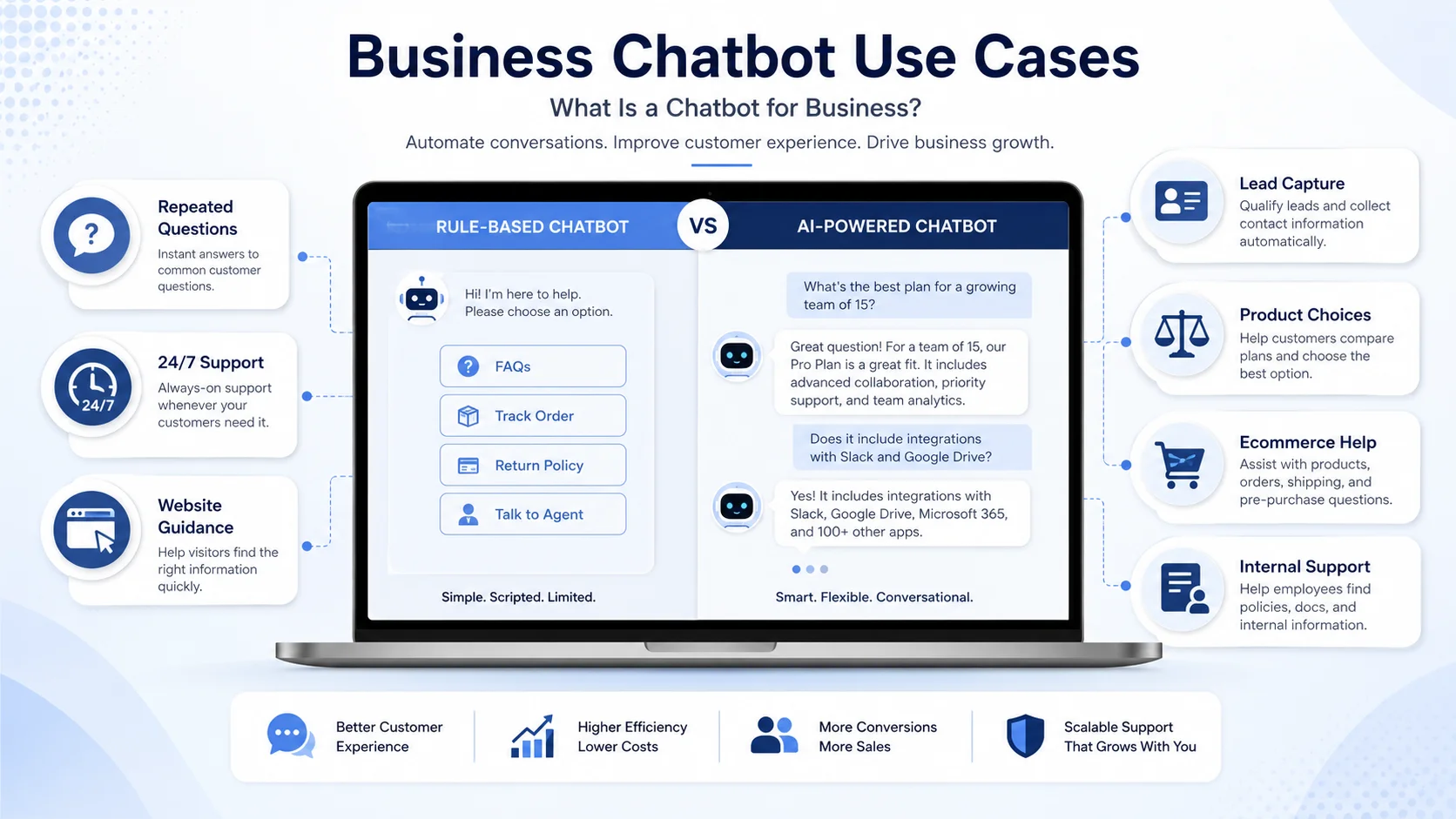
Traditional chatbots usually follow scripts, buttons and predefined conversation paths. AI chatbots use technologies such as natural language processing and large language models to understand more flexible questions and generate responses based on available information.
For example, a traditional chatbot may ask a visitor to choose between “Pricing,” “Support,” and “Contact Sales.” An AI chatbot may allow the same visitor to ask, “Which plan is suitable for a small company with three websites?” and respond using the company’s pricing information.
The right type depends on the task. A rule-based chatbot may be enough for a short, predictable process, while an AI chatbot is usually more useful when visitors ask questions in many different ways.
1. You Receive the Same Questions Repeatedly
A chatbot becomes useful when your team spends a significant amount of time answering routine questions. Customers may repeatedly ask about business hours, pricing, delivery, availability, returns, booking procedures, service areas, product features or account support. These questions are important, but answering them manually every time can reduce the time available for more complicated work.
A chatbot can provide immediate answers using approved FAQs, website pages, policies and support documents. When the question falls outside its knowledge, it should offer a human-support option rather than create an answer.
Before adding a chatbot, review your recent emails, contact forms, support tickets and live-chat conversations. If the same questions appear regularly and have clear answers, you have a strong chatbot use case.
2. Customers Need Help Outside Working Hours
Your website may remain open all day, even when your employees are unavailable. Visitors can arrive during evenings, weekends, holidays or from a different time zone. They may want to confirm a product feature, understand a policy, check pricing or find the correct service page before taking action.
A chatbot can provide suitable assistance during these periods. It may answer the question immediately or collect the visitor’s details for later follow-up.
This does not mean the chatbot must resolve every request. Its purpose is to prevent customers from reaching a complete dead end when no employee is online. Around-the-clock availability remains one of the practical reasons businesses use customer-facing chatbots.
3. Visitors Struggle to Find Information on Your Website
A website can contain useful information and still be difficult to navigate. A visitor may not know whether the answer is located on a product page, pricing page, FAQ, policy, knowledge base or contact page. After searching for a few minutes, the person may leave instead of continuing.
A chatbot creates a conversational way to access this information. The visitor can ask a direct question such as: “Do you provide this service to companies outside the UK?”
The chatbot can answer from the company’s service information or guide the visitor to the relevant page. This is especially helpful for businesses with large websites, detailed product catalogues, multiple services or extensive support documentation.
4. Your Team Is Missing Website Leads
Not every interested visitor is ready to complete a long contact form. Some people want to ask one or two questions before sharing their information. Others may be unsure which department, product or service they need.
A chatbot can begin with the visitor’s actual question and collect lead details naturally when follow-up is appropriate. It might ask about the visitor’s requirement, business type, preferred service, expected timeline and contact method. The conversation can then be transferred to the sales team with useful context.
This approach is particularly valuable when the business receives many enquiries but struggles to understand their quality or intent. The chatbot can support initial qualification without pretending that every visitor is ready to buy.
5. Customers Need Guidance Between Several Options
A chatbot is useful when customers regularly need help choosing between products, services, plans or packages. For example, a software company may offer several plans with different usage limits. A service company may provide different solutions depending on company size or project requirements. A real estate website may need to guide visitors according to location, budget and property type.
The chatbot can ask a few relevant questions, explain the available differences and direct the visitor toward suitable information. It should not make unsupported promises or make important decisions on behalf of the customer. Its role is to simplify the choice, not manipulate it.
6. Your Ecommerce Store Has Repeated Pre-Purchase Questions
Ecommerce is a strong chatbot use case because shoppers often need answers before completing a purchase. A customer may ask about product size, materials, compatibility, delivery time, payment options, stock information or return conditions. If these answers are difficult to find, the shopper may delay or abandon the purchase.
An ecommerce chatbot can use the store’s product and policy information to assist with product discovery, comparisons, FAQs, checkout guidance and post-purchase support. Modern ecommerce chatbots increasingly use AI and business data rather than relying only on rigid decision trees. For example, a customer might ask: “Which of these office chairs is suitable for someone who works eight hours a day?”
The chatbot can compare published features such as lumbar support, adjustability, materials and weight limits. It should explain the available information without inventing health benefits or guarantees. The chatbot’s capabilities will depend on its integrations. It may explain the order-tracking process without being able to access a specific order unless it is securely connected to the required system.
7. Your Employees Spend Too Much Time Finding Information
Chatbots are not only for customers. A business may also use an internal chatbot to help employees locate policies, procedures, technical documentation, product information or HR guidance.
Instead of searching through folders, internal portals or long documents, an employee can ask a direct question and receive information from approved internal sources. Enterprise chatbots are increasingly used for both customer-facing and employee-support scenarios, including HR, IT, sales and service workflows.
Internal chatbots still require strong access controls. Employees should only receive information they are authorised to view, particularly when the knowledge base contains confidential business or customer data.
When a Business Should Not Use a Chatbot
A chatbot is not automatically the right answer for every business. You may not need one when website traffic and enquiry volume are very low, repeated questions are rare or almost every customer conversation requires detailed personal judgment.
A chatbot may also be the wrong starting point when your website information is outdated or inconsistent. If different pages show conflicting prices, policies or service details, the chatbot may repeat those problems rather than solve them.
You should also reconsider automation when conversations involve sensitive legal, medical, financial, emotional or high-risk decisions. A chatbot may provide basic navigation or collect initial information, but qualified human assistance should remain central. The following situations usually require extra caution:
Payment disputes and unusual refund decisions
Sensitive personal or account information
Legal or regulated advice
Emotional complaints
Complex technical emergencies
Custom negotiations
Decisions requiring management approval
A business chatbot should make human support easier to reach, not hide it behind more automation.
Rule-Based Chatbot or AI Chatbot?
A rule-based chatbot is suitable when conversations are predictable and the available choices are limited. It may work well for collecting contact details, directing visitors to departments or answering a small group of fixed questions.
An AI chatbot is more suitable when customers ask questions in different ways, need follow-up explanations or want answers from a larger knowledge base. For example, a rule-based chatbot may guide a user through five booking options. An AI chatbot may be more appropriate when the visitor wants to describe their requirements and ask which service fits them.
Some businesses combine both approaches. Structured buttons provide clear navigation, while AI handles open-ended questions. The best choice depends on user needs rather than which technology sounds more advanced.
Is Your Business Ready for a Chatbot?
Before choosing a platform, confirm that your business has a clear problem to solve and reliable information the chatbot can use. You are more likely to be ready when:
You can identify the conversations you want to automate.
Your website, FAQs, policies and product information are accurate.
You know which questions require human assistance.
Your team can regularly review chatbot conversations.
You have a process for updating its knowledge.
You understand what customer data it may collect.
You have a measurable goal for the chatbot.
That goal might be reducing repeated support questions, increasing qualified enquiries, improving website navigation or helping ecommerce shoppers make informed decisions. Starting with one focused use case is usually more effective than asking the chatbot to handle every business conversation from the first day.
How to Introduce a Chatbot to Your Business
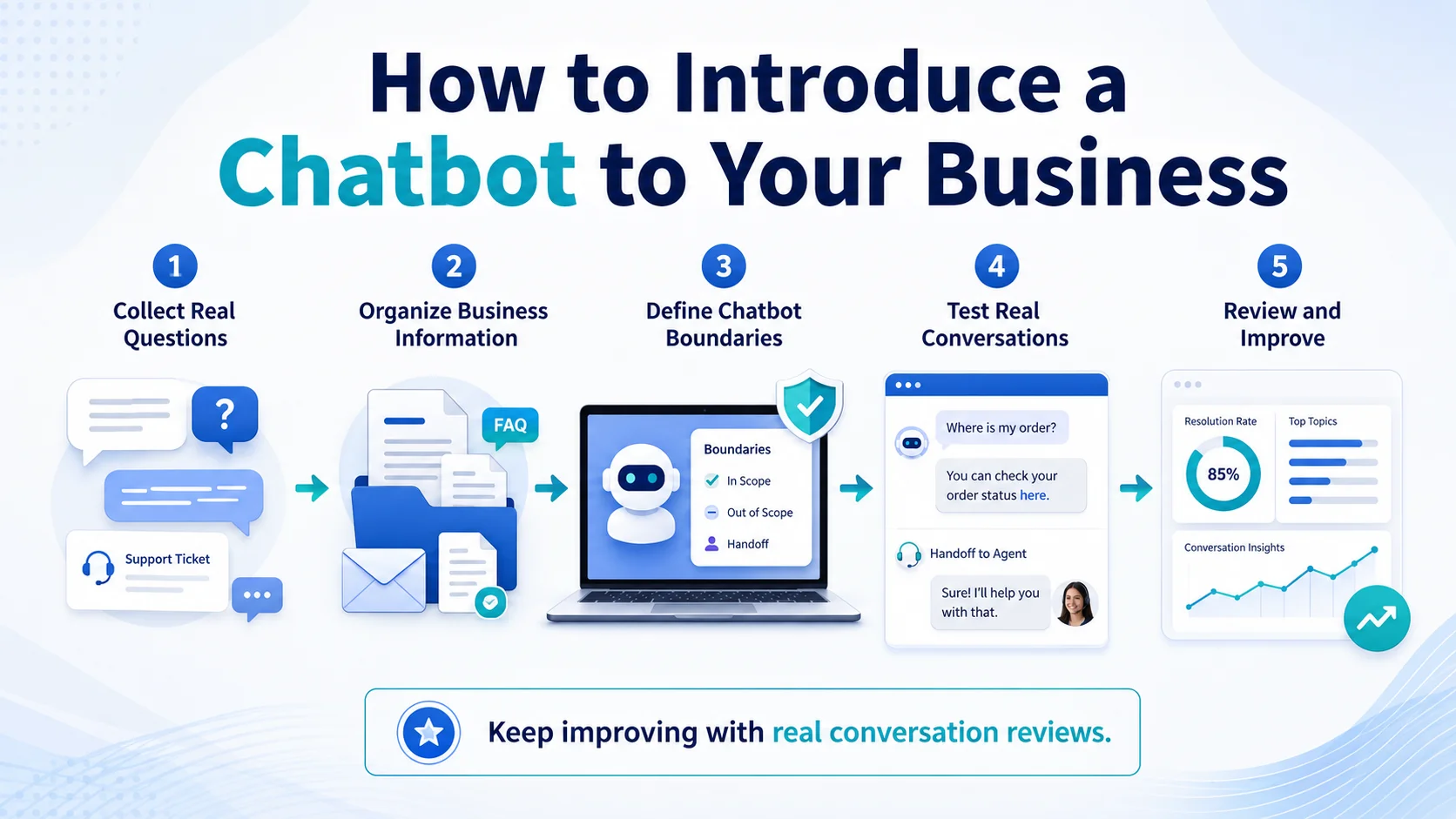
Begin by collecting real questions from customers. Review support tickets, emails, sales calls, website searches and live-chat records to understand where people experience difficulty.
Next organise the information needed to answer those questions. This may include website pages, FAQs, pricing documents, product information, policies and support guides. Define what the chatbot can answer and when it must involve a person. Then test it using realistic messages, including short questions, spelling mistakes, unclear wording, follow-up questions and requests outside its approved scope.
After launch, review its conversations rather than assuming the setup is complete. Look for incorrect answers, unresolved questions, repeated handoffs and information missing from your website. A chatbot becomes more useful when it is treated as an ongoing customer communication channel rather than a widget installed once and forgotten.
How AgentBest.ai Supports Business Chatbots
AgentBest.ai helps businesses create a chatbot using their existing website content and additional knowledge. The platform can learn from products, services, FAQs, policies, pricing information and other important website pages. Businesses can also upload PDFs, manuals, support documents and additional knowledge to improve its answers.
After setup, the chatbot can be deployed on a business website to answer visitor questions, guide users, collect enquiries, support customer and sales conversations and transfer complex requests to a human team member.
For an ecommerce store, this may involve helping shoppers understand products and policies. For a SaaS company, it may involve explaining features and plans. For a service business, it can guide visitors toward the right service or contact option.
Final Thoughts
You should use a chatbot for business when it solves a repeated and measurable communication problem. It may be the right choice when customers need help outside working hours, visitors struggle to find information, employees answer the same questions repeatedly or your website is losing enquiries because assistance is unavailable.
It may not be suitable when your business information is unreliable, conversation volume is extremely low or most requests require sensitive human judgment. The best chatbot does not attempt to replace every conversation. It handles suitable questions quickly, guides people toward useful information and knows when a person should take over.