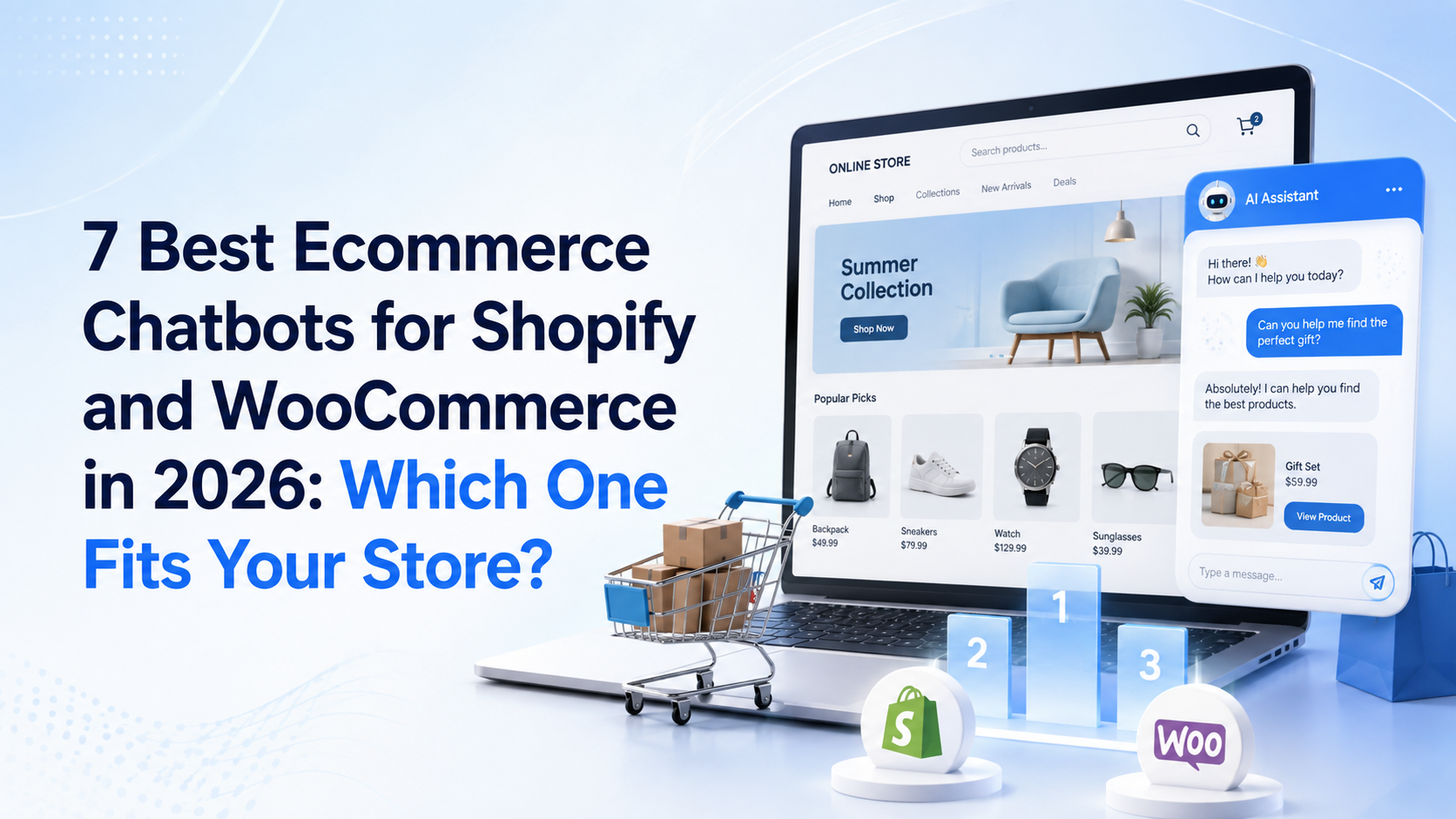
A Shopify merchant and a WooCommerce merchant can have exactly the same problem: shoppers have questions while they are deciding whether to buy. But the chatbot that works well for one store may not offer the same functionality on the other platform.
One shopper might ask, “Which of these jackets is waterproof?” Another wants to know, “Where is my order?” A third needs help understanding the return policy. Product guidance can often come from store content, while order-specific questions require access to live ecommerce data.
That is why comparing the best ecommerce chatbots requires more than checking whether a chatbot can be installed on Shopify or WordPress. You need to know what it can actually do after installation.
In this guide, we compare seven strong ecommerce chatbot options based on their current 2026 capabilities, with particular attention to Shopify and WooCommerce support, product discovery, customer service, order assistance, AI knowledge, and human handoff.
Disclosure: AgentBest.ai publishes this article and is included in the comparison. The numbering is intended to organize the options rather than claim one platform is universally the best choice for every ecommerce business.
What Should an Ecommerce Chatbot Actually Do?
A basic ecommerce chatbot may answer FAQs or display buttons for shipping, returns, and customer support. Modern AI chatbots can go considerably further. Depending on the platform and integration, they may help customers:
- Discover relevant products
- Compare products and variants
- Ask sizing or compatibility questions
- Understand shipping and return policies
- Receive personalized product suggestions
- Access order information
- Review their shopping cart
- Complete certain approved actions
- Contact a human when AI cannot resolve the issue
The important phrase is depending on the integration. A chatbot trained on your website can explain your return policy. That does not automatically mean it can check whether a specific customer's refund has been processed.
Our AI chatbot for ecommerce website guide explains this difference between website knowledge and live ecommerce data in more detail.
Best Ecommerce Chatbots at a Glance
| Chatbot | Shopify | WooCommerce | Best For |
|---|---|---|---|
| AgentBest.ai | Yes | Yes | No-code store-trained product and support assistant |
| Tidio Lyro | Yes | Yes | SMB ecommerce, AI recommendations + live chat |
| Crisp AI Agent | Yes | Yes | Ecommerce support with customer/order context |
| Re:amaze | Yes | Yes | Ecommerce helpdesk, order support, and automated chat |
| Intercom Fin for Ecommerce | Native | Connector/beta setup | Advanced shopping + support conversations |
| Gorgias AI Agent | Yes | AI Agent not supported | Deep Shopify-specific ecommerce automation |
| Chatbase | Native | No equivalent native integration documented | Flexible Shopify AI actions and product discovery |
If your main requirement is both Shopify and WooCommerce, the first four options deserve particular attention because they currently document support for both platforms.
1. Agent Best AI: Best for No-Code Shopify and WooCommerce Website Training
Agent Best AI is designed around a straightforward idea: use the information already available throughout an ecommerce website to create an AI shopping and support assistant.
A store owner can provide the website URL, and AgentBest.ai can learn from products, collections, categories, FAQs, shipping information, return policies, and other published store content. Additional materials such as product guides, size charts, manuals, and support documents can also expand the chatbot's knowledge.
Ecommerce Capabilities
AgentBest.ai can help with:
- Product search and discovery
- Product recommendations
- Product comparisons
- Product and sizing questions
- Shipping and return questions
- Store-policy explanations
- Lead and enquiry capture
- Human handoff
- Additional document knowledge
- Website recrawling when content changes
It currently documents support for both Shopify and WooCommerce, which is important for merchants who want a similar chatbot approach regardless of which platform they use.
Why It Stands Out
The strongest advantage is the website-first setup. Imagine your WooCommerce store already has detailed product descriptions, compatibility information, return conditions, and FAQs. Instead of manually writing hundreds of chatbot responses, the AI can use those existing sources as its starting knowledge.
A shopper might ask: “Which of these backpacks fits a 16-inch laptop?” If that information appears in the product content, the chatbot can guide them toward the relevant options. If the shopper then says: “I bought it last week and support refused my return,” that conversation may require human assistance rather than another automated response.
Best For
AgentBest.ai is a good fit for:
- Shopify stores
- WooCommerce stores
- Small and growing ecommerce businesses
- Businesses wanting no-code deployment
- Product and policy-heavy websites
- Stores prioritizing pre-purchase questions
- Teams wanting AI support plus human handoff
The main distinction to understand is that learning from store content is not the same as accessing live customer transactions. Real-time orders, inventory, or account actions require the appropriate system connection.
You can also review the dedicated AgentBest.ai ecommerce AI chatbot solution for its currently documented store capabilities.
2. Tidio Lyro: Best for Smaller Stores Wanting AI and Live Chat Together
Tidio is especially relevant to merchants who want AI automation while keeping traditional live chat close at hand.
Its Lyro AI Agent has dedicated Product Recommendations integrations for both Shopify and WooCommerce. According to Tidio's current documentation, Lyro can recommend products based on what shoppers ask, distinguish between products and variants, and suggest complementary items.
What Lyro Can Help With
Depending on configuration, Tidio can support:
- Product recommendations
- Product and variant discovery
- Customer-support questions
- Pre-purchase conversations
- FAQ assistance
- Live-chat escalation
- Product cards inside conversations
- Complementary-product suggestions
For Shopify, Tidio has also expanded Lyro's shopping functionality to account for product and cart information in relevant recommendation experiences.
Why It Works Well for SMB Ecommerce
A smaller fashion store may not need an enterprise support platform with complicated ticket routing and hundreds of automation rules. It may simply need the AI to answer:
- “Do you have this in medium?”
- “What shoes would go with this jacket?”
- “Can I return this if the size is wrong?”
and then let a human join when necessary. That AI-plus-live-chat combination is where Tidio remains attractive.
Best for: Small and mid-sized Shopify or WooCommerce businesses that want product recommendations, AI customer support, and human live chat in one customer-communication environment.
3. Crisp AI Agent: Best for Shopify and WooCommerce Order Context
Crisp has become particularly interesting for ecommerce because its current AI setup can connect directly with both Shopify and WooCommerce, while keeping customer and order context near the conversation.
For WooCommerce, Crisp's integration can sync customer information, cart context, past orders, and order events. Crisp also documents an AI-powered “Where is my order?” workflow for ecommerce stores.
When Shopify, WooCommerce, or another supported ecommerce integration is connected, Crisp's AI Agent can retrieve relevant order details and answer customers automatically.
Ecommerce Capabilities
Crisp can support:
- Customer-service conversations
- Customer and order context
- “Where is my order?” requests
- Shopify integration
- WooCommerce integration
- Pre-sale questions
- Knowledge-based AI answers
- Multilingual conversations
- Human handoff
- Shared support channels
For WooCommerce stores specifically, the native plugin adds the Crisp chatbox and connects store information with the customer-support environment.
Why It Stands Out
Crisp is particularly useful when your main problem is not only helping people choose products, but also providing better support after the purchase. Consider: Customer: “Where's my order?” A website-only chatbot may explain how order tracking normally works.
Crisp's ecommerce AI can use the connected order system to retrieve relevant order details when correctly configured. That is an important difference.
Best for: Shopify and WooCommerce businesses that want AI support connected more closely to ecommerce customer and order information, while retaining a broader customer-support workspace.
4. Re:amaze: Best for Ecommerce Helpdesk + Automated Chatbots
Re:amaze approaches the problem from a helpdesk and customer-engagement perspective. It provides several ecommerce chatbot tools, including an Order Bot, FAQ Bot, custom bots, and broader support automation.
Its Order Bot currently works with Shopify, BigCommerce, and WooCommerce, allowing customers to retrieve recent order-status information without necessarily involving a support representative.
Main Ecommerce Uses
Re:amaze can help businesses with:
- Order-status questions
- FAQ automation
- Product guidance through custom bots
- Lead qualification
- Customer-service automation
- Human-agent escalation
- Ecommerce support workflows
- Live chat
Its custom chatbot functionality also allows merchants to build more tailored flows for product guidance and other customer interactions.
Why It May Be the Right Choice
Re:amaze makes sense when the chatbot is only one piece of your customer-service operation.
For example, customers might first interact with an automated order bot, then move into a human-support conversation if their delivery is delayed or another problem needs investigation. That is different from a platform whose main purpose is purely conversational product discovery.
Best for: Shopify and WooCommerce merchants that want chatbots integrated into a wider ecommerce helpdesk and customer-support environment.
5. Intercom Fin for Ecommerce: Best for Advanced Shopping + Support
Intercom significantly expanded Fin's ecommerce capabilities in 2026. Fin for Ecommerce combines shopping assistance and customer support in the same conversation. It can use product catalogues to help customers discover, compare, and choose products, then move into support requests such as returns or order updates where the necessary procedures and integrations are configured.
Shopify Support
Shopify currently has the deepest Fin ecommerce integration. Connecting a Shopify store imports products and storefront content, while information such as pricing, variants, and availability can remain synchronized with the catalogue. Fin can then be tested against product recommendations, product comparisons, carts, checkout, and customer-support questions.
What About WooCommerce?
Fin can also be used with WooCommerce and other ecommerce systems through a catalog connector rather than the same one-click Shopify experience. Intercom currently describes non-Shopify ecommerce support as initially being available through a closed beta and requiring developer work to publish the product catalogue.
That difference matters. Shopify merchants receive the more native integration, while WooCommerce merchants should verify current access and technical requirements before choosing it.
Ecommerce Capabilities
Fin for Ecommerce includes:
- Product discovery
- Product recommendations
- Product comparisons
- Catalogue search
- Shopping guidance
- Cart and checkout assistance
- Returns and refunds
- Order updates
- Human escalation
- Ecommerce-specific analytics
For Shopify stores, Intercom also provides revenue-attribution reporting around orders influenced by Fin conversations.Best for: Established ecommerce businesses that want a sophisticated AI combining sales assistance and customer support, especially on Shopify.
6. Gorgias AI Agent: Best for Deep Shopify-Specific Ecommerce Automation
Gorgias deserves a place in any serious ecommerce chatbot comparison, but there is an important limitation for this particular article: Its AI Agent currently supports Shopify, not WooCommerce.
Gorgias's own compatibility documentation states that Shopify is fully compatible with AI Agent, while WooCommerce and PrestaShop are not currently supported for AI Agent.
Why Include It Then?
Because for Shopify merchants, Gorgias offers some of the deepest ecommerce-specific AI capabilities available. Its Shopping Assistant can help customers discover products, answer sales questions, make product recommendations, and guide shoppers toward a purchase. Gorgias can also use information from:
- Shopify product catalogues
- Store product pages
- Public website content
- Help-center articles
- Orders and customer data
- Custom business guidance
Its current documentation explains that AI Agent combines Shopify catalogue data, website product information, and custom product knowledge when assisting shoppers.
Shopping Assistance
For Shopify, Gorgias can support:
- Product discovery
- Product recommendations
- Product questions
- AI-generated product FAQs
- Sizing and material questions
- Search assistance
- Discount strategies
- Order management
- Customer-support automation
- Human handoff
Its AI FAQs can even generate useful product questions based on information from the product page, including areas such as sizing, materials, shipping, and returns.
Best for: Shopify businesses that want an ecommerce-specific AI deeply connected to product, customer, order, and helpdesk data. Not the best fit if: WooCommerce support is a requirement today.
7. Chatbase: Best for Flexible Shopify AI Actions
Chatbase is another platform that has become substantially more ecommerce-focused through its native Shopify integration.
Once connected, a Chatbase AI agent can help shoppers browse products, retrieve orders, manage cart information, and update certain customer account details through chat.
Shopify Actions
Current Chatbase Shopify actions include:
- Search products
- Display products
- Add products to cart
- Retrieve orders
- Show order status
- Show current cart
- Update profile information
- Update billing addresses
Product data can also synchronize with Shopify after the initial import so additions, changes, and deletions remain reflected in the agent's product information. That makes Chatbase more than a website-trained FAQ chatbot for Shopify.
Example
A customer could ask: “Show me red dresses under $50.” The agent can search the Shopify catalogue and return relevant products. The same shopper might later ask: “What's in my cart?” A configured Shopify action can retrieve that information.
WooCommerce Consideration
Chatbase's currently documented native ecommerce integration focuses on Shopify. Businesses wanting similar live WooCommerce functionality would need to evaluate whether custom actions or another integration architecture can meet their requirements rather than assuming parity with the Shopify setup.
Best for: Shopify businesses wanting a flexible general AI-agent platform with increasingly strong native ecommerce actions.
Which Are the Best Ecommerce Chatbots for Both Shopify and WooCommerce?
If your business specifically needs native or clearly documented support for both platforms, the shortlist changes.
- Agent Best AI
Best when the priority is using existing store content to provide product guidance, policy answers, ecommerce support, and human handoff without a complex development project. It explicitly documents both Shopify and WooCommerce support.
- Tidio Lyro
A strong choice when you want AI product recommendations combined with traditional live chat. Tidio documents dedicated Product Recommendation integrations for both Shopify and WooCommerce.
- Crisp
Especially useful when order context and post-purchase customer support matter. Crisp currently connects to both Shopify and WooCommerce and supports ecommerce AI workflows such as order-status assistance.
- Re:amaze
A good option when chatbot automation needs to sit inside an ecommerce helpdesk. Its Order Bot works across Shopify and WooCommerce.
These are not automatically “better” than Gorgias or Fin. They simply offer a more straightforward cross-platform story for merchants who care about both Shopify and WooCommerce.
Shopify vs WooCommerce Chatbots: Why Platform Support Matters
You should not assume that because a chatbot displays correctly on a WooCommerce website, it offers the same WooCommerce capabilities as it does on Shopify. There are several levels of integration.
Level 1: Website Widget
The chatbot can appear on your store. This alone says almost nothing about what ecommerce data it can access.
Level 2: Website or Knowledge Training
The chatbot can understand information such as:
- Products
- Categories
- FAQs
- Shipping
- Returns
- Policies
AgentBest.ai's ecommerce setup is an example of this website-first approach across Shopify and WooCommerce.
Level 3: Product Catalogue Integration
The chatbot can directly search structured catalogue data and potentially remain synchronized as products change. Tidio, Chatbase, Gorgias, and Intercom offer versions of this capability depending on platform and configuration.
Level 4: Customer and Order Data
The chatbot can answer: “Where is my order?” rather than merely explaining where tracking information normally appears. Crisp, Chatbase, Gorgias, and other tightly connected platforms can support versions of this functionality when their relevant ecommerce integration is enabled.
Level 5: Ecommerce Actions
The chatbot may actually perform approved actions such as:
- Add an item to cart
- Update customer information
- Process an approved workflow
- Modify an order
- Start a return
This is where integration depth becomes much more important than simply calling something an “AI ecommerce chatbot.”
Which Chatbot Is Best for a Shopify Store?
Shopify merchants currently have the widest range of deeply integrated AI chatbot options. For different priorities:
- AgentBest.ai: Store-trained no-code product and policy assistant
- Gorgias: Deep Shopify sales + support automation
- Intercom Fin: Advanced shopping and support agent
- Tidio: SMB AI + live chat
- Chatbase: Flexible Shopify actions
- Crisp: Order context and multichannel customer communication
- Re:amaze: Ecommerce helpdesk + chatbot automation
If your store has high support volume and needs access to customer/order workflows, deeper Shopify-native options such as Gorgias or Fin deserve close evaluation.
If you primarily want customers to understand products, compare options, ask policy questions, and move to human assistance when needed, a website-trained tool such as Agent Best AI may provide a simpler setup.
Which Chatbot Is Best for a WooCommerce Store?
WooCommerce requires a little more care because many ecommerce AI products still prioritize Shopify. For WooCommerce specifically, the strongest options from this list are:
- AgentBest.ai for website-trained product and support conversations
- Tidio Lyro for AI product recommendations and live chat
- Crisp for order/customer context and AI support
- Re:amaze for ecommerce helpdesk and order automation
Intercom Fin is also moving beyond Shopify and documents WooCommerce catalogue connectivity, but its non-Shopify ecommerce implementation currently involves additional technical requirements and limited-access rollout compared with its native Shopify integration.
Gorgias AI Agent, by contrast, currently states explicitly that WooCommerce is not supported. That is why platform-specific research matters before buying.
What Should You Test Before Choosing an Ecommerce Chatbot?
Do not evaluate an ecommerce chatbot only using its demo conversation. Connect it to realistic data and ask the types of questions your shoppers actually send. For example:
- “need waterproof jacket under $100”
- “whats difference between these 2?”
- “this fit iphone pro?”
- “can sale items be returned?”
- “wrong size, can i exchange?”
- “where is order 10458?”
- “can you cancel the order?”
- “support already refused my refund”
Then check how it behaves. Does it understand natural, imperfect wording? Does it retrieve the right product? Does it invent information when the answer is missing? Can it tell the difference between a normal policy question and a customer-specific dispute?
Those edge cases tell you much more than asking: “What is your return policy?”
8 Features Worth Comparing
When narrowing your shortlist, focus on capabilities that affect the actual customer experience.
1. Product Knowledge
Can the chatbot understand product descriptions, specifications, categories, variants, and compatibility?
2. Product Discovery
Can a shopper say: “I need something waterproof under $150” instead of navigating filters manually?
3. Product Recommendations
Can the AI recommend only products that genuinely match information in the store?
4. Shopify or WooCommerce Integration
Check the specific capabilities available on your platform, not the provider's general ecommerce marketing page.
5. Order Support
Can it explain tracking procedures only, or can it retrieve a specific customer's actual order?
6. Human Handoff
Can customers reach a person when the conversation involves complaints, refunds, unusual requests, or missing information?
7. Knowledge Updates
What happens when you change a price, launch a product, or revise the return policy? An outdated chatbot can deliver an incorrect answer with complete confidence.
8. Analytics
Useful analytics should tell you more than how many people opened the chat. Look for insights such as:
- Common questions
- Unresolved conversations
- Product-discovery interactions
- AI resolutions
- Human escalations
- Knowledge gaps
- Influenced purchases, where supported
Product Recommendations Need Accurate Data
One of the most attractive ecommerce chatbot features is conversational recommendation. A shopper might say: “I need running shoes for wet trails under $150.” The AI can potentially interpret:
- Activity: trail running
- Condition: wet
- Budget: under $150
But the recommendation should still come from reliable product information. If no product is documented as suitable for wet trail use, the chatbot should not invent that suitability merely because another product looks similar.
This principle applies whether you use AgentBest.ai, Tidio, Gorgias, Fin, Chatbase, Crisp, or another platform. The AI is only useful when the information underneath it is trustworthy.
Don't Confuse Customer Support With Shopping Assistance
The best ecommerce chatbots increasingly combine both, but these are still different jobs.
Shopping Assistance
This includes:
- Finding products
- Comparing options
- Explaining differences
- Answering pre-purchase questions
- Helping customers understand sizes or compatibility
Customer Support
This includes:
- Shipping questions
- Returns
- Exchanges
- Damaged products
- Order tracking
- Account issues
A chatbot can be excellent at support but limited at product discovery, or strong at shopping assistance but less integrated with post-purchase systems.
Decide which side of the buying journey matters most before choosing.
Should Your Chatbot Have Access to Customer Data?
Not unless it needs it. A chatbot answering product questions does not require the customer's complete order history. A chatbot retrieving an individual shipment obviously needs more information. The deeper the integration, the more carefully you should evaluate:
- Authentication
- Customer permissions
- Data access
- Data retention
- Staff access
- Privacy controls
- Integration security
Do not choose deeper data access simply because it sounds more advanced. Use the minimum access required to provide the experience you actually want.
A Simple Decision Guide
- Choose Agent Best AI when you want a no-code chatbot that learns from Shopify or WooCommerce store content and focuses on product guidance, policies, support, and human handoff.
- Choose Tidio when your smaller or mid-sized store wants AI product recommendations alongside live chat on either Shopify or WooCommerce.
- Choose Crisp when customer/order context and post-purchase support matter across Shopify and WooCommerce.
- Choose Re:amaze when the chatbot needs to operate inside a broader ecommerce helpdesk.
- Choose Intercom Fin when you want sophisticated shopping and customer-support capabilities and are comfortable with a more advanced setup particularly on Shopify.
- Choose Gorgias when you run Shopify and want a deeply ecommerce-specific AI sales and support environment.
- Choose Chatbase when you use Shopify and want flexible AI-agent actions around products, carts, orders, and customer information.
Final Thoughts
There is no single winner among the best ecommerce chatbots because Shopify and WooCommerce businesses do not all need the same thing.
Some stores mainly need faster answers about products, sizing, compatibility, shipping, and returns. Others need the AI connected deeply enough to access customer orders, manage carts, or support post-purchase workflows.
For stores that want one straightforward AI chatbot approach across both Shopify and WooCommerce, AgentBest.ai, Tidio, Crisp, and Re:amaze are strong options to investigate first.
Shopify merchants have additional deeply integrated choices such as Gorgias AI Agent, Intercom Fin for Ecommerce, and Chatbase. The right decision starts with your customers, not the software.
Write down the questions shoppers actually ask. Identify which ones require website knowledge, which need live store data, and which should always reach a person. Then test each chatbot against those conversations.
The best ecommerce chatbot is not the one that automates the most. It is the one that helps shoppers get the right information at the right point in their buying journey and knows when AI should step aside.
=========================================================