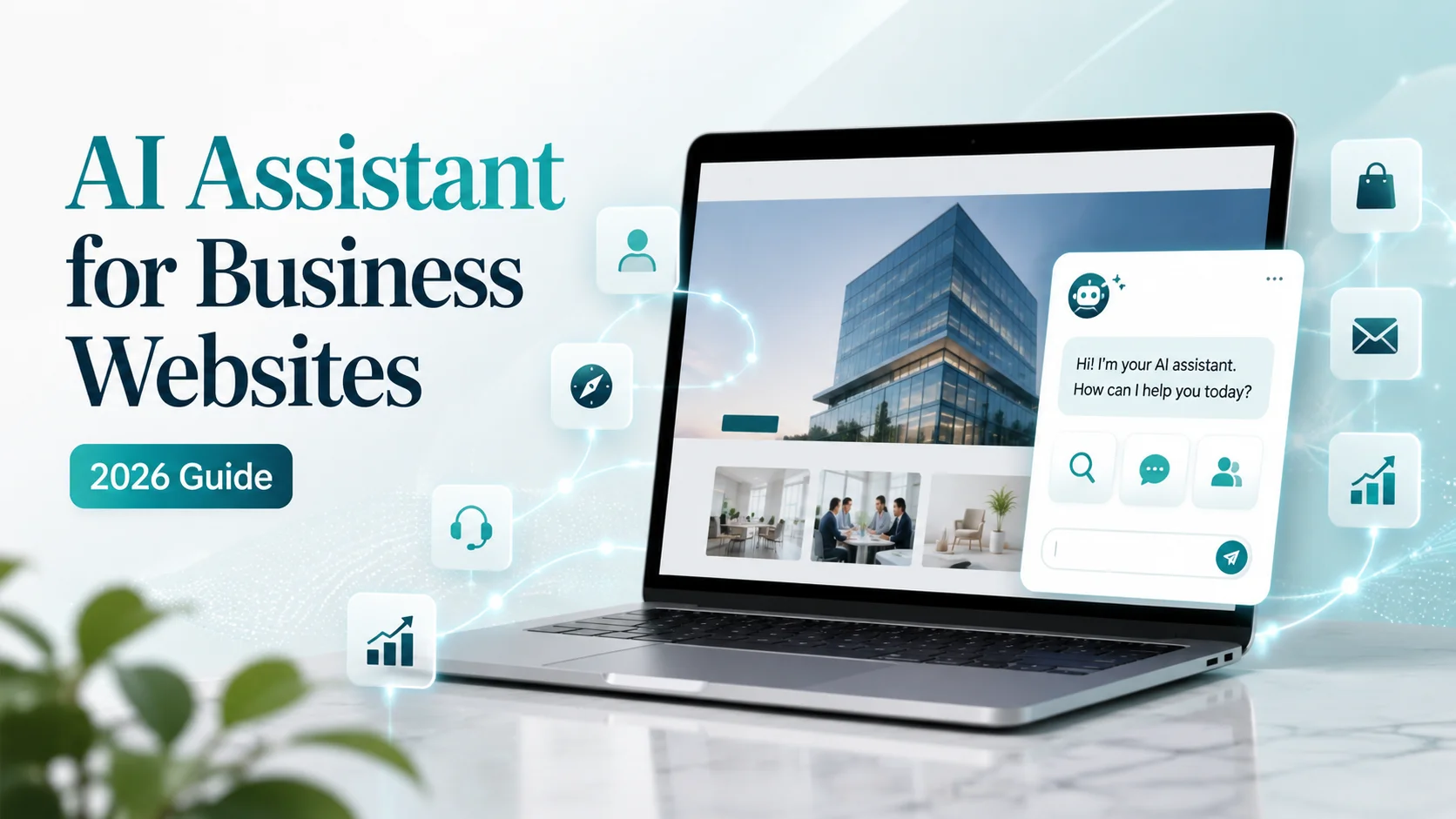
What Is an AI Assistant for a Business Website?
An AI assistant for a business website is a conversational tool that helps visitors interact with business information through natural language.
Instead of manually searching through product pages, service descriptions, FAQs, policies or support documents, a visitor can ask a direct question. The assistant searches the knowledge available to it and provides a relevant response.
For example, a visitor might ask: “Which of your services is suitable for a small ecommerce store?”
The assistant can explain the available options using the company’s actual service information and guide the visitor to the most relevant page.
Modern conversational AI can understand user intent, follow the context of a conversation, provide guidance, collect information and support website navigation.
AI Assistant vs Chatbot vs AI Agent
These terms are often used interchangeably, but they do not always mean the same thing. A traditional chatbot usually follows predefined scripts, buttons or decision trees. It works well for simple questions but may struggle when a visitor uses unexpected wording.
An AI assistant can understand more natural questions, use business knowledge, remember the current conversation and provide more flexible guidance. Its main role is usually to assist the user by answering, explaining, recommending or directing them to the next step.
An AI agent may go further by using connected tools to complete approved multi-step actions. For example, an assistant might explain how to request a refund, while an integrated AI agent could potentially begin the refund process. IBM distinguishes assistants as primarily conversational support systems, while agents can plan actions and coordinate more complex tasks with greater autonomy.
The actual capabilities depend on the platform and its integrations. Businesses should evaluate what a system can genuinely do rather than relying only on the words “assistant” or “agent.”
How Does a Website AI Assistant Work?
A business first provides the information the assistant is allowed to use. This may include website pages, product descriptions, service details, FAQs, pricing information, policies, manuals and uploaded documents.
When a visitor asks a question, the assistant tries to understand the intent behind it. It then searches the available business knowledge and creates a clear response based on relevant information.
For example, if someone asks about delivery, the assistant should use the company’s real shipping policy rather than provide a general answer about how delivery usually works.
The conversation may then continue with a follow-up question. If the visitor first asks about a service and then says, “How long does it take?”, the assistant should understand which service is being discussed.
When reliable information is unavailable, the assistant should say that it cannot confirm the answer and offer a human-support option instead of guessing.
What Can an AI Assistant Do on a Business Website?
A website AI assistant can support several parts of the visitor journey.
Answer Common Questions
The assistant can respond to repeated questions about products, services, prices, availability, delivery, returns, policies, bookings and business processes.
This gives visitors faster access to information and reduces the number of basic questions employees must answer manually.
Guide Visitors Through the Website
Some visitors know what they need but cannot find the right page. An AI assistant can direct them to a product, service, pricing page, policy, support article, booking form or contact option. This is particularly useful for websites with many pages or complex navigation.
Explain Products and Services
A visitor may not understand the difference between two plans or services. The assistant can explain the main differences and help the user identify which information is most relevant to their needs.
It should provide guidance based on approved business content rather than making unsupported promises or decisions for the visitor.
Support Customer Service
The assistant can answer routine support questions, provide basic troubleshooting guidance, explain policies and collect details before a human takes over.
AI assistants can provide real-time support across digital channels, guide users through self-service options and escalate complex issues when necessary.
Capture Leads and Enquiries
Instead of asking visitors to complete a long contact form, an AI assistant can collect information through a natural conversation.
It may ask what the visitor needs, which product or service interests them and how they would prefer to be contacted. The enquiry can then be passed to the appropriate team member.
Assist Visitors Outside Working Hours
Business websites remain available when employees are offline. An AI assistant can provide suitable information during evenings, weekends and across different time zones. It can also collect details for requests that require later human follow-up.
Conversational AI is commonly used to provide continuous assistance while allowing human teams to focus on more complicated situations.
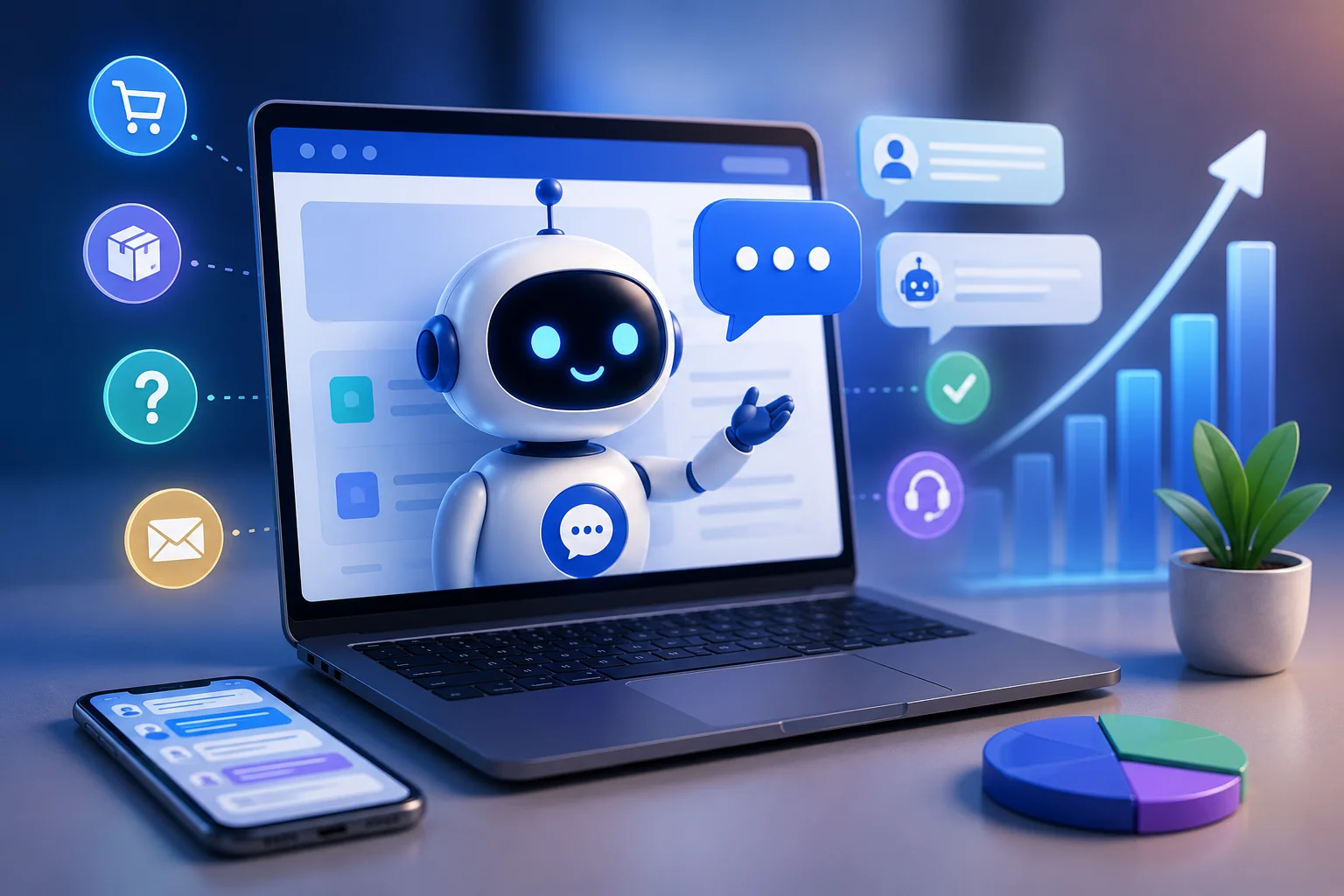
How an AI Assistant Helps Ecommerce Websites
Ecommerce shoppers often need guidance before they feel ready to purchase. A visitor may want to compare products, check sizing, confirm compatibility, understand delivery conditions or review the return policy. An ecommerce AI assistant can answer these questions using the store’s own product and policy information.
For example, a shopper may ask: “Which of these backpacks is better for a 15-inch laptop and daily travel?”
The assistant can compare the published sizes, materials, compartments and features of relevant products. It should explain why an option may fit the shopper’s needs without making claims that are not supported by the product data.
An ecommerce assistant may also help visitors find collections, understand promotions, navigate store policies or reach human support. More advanced retail systems are moving toward connected shopping experiences that combine product discovery, customer service and approved commerce actions.
However, businesses must be clear about current capabilities. An assistant may explain how to track an order without having access to the order itself unless the required integration is available.
Why Businesses Are Adding AI Assistants in 2026
The role of website assistants is expanding because businesses want to provide faster digital support without making every interaction dependent on employee availability.
According to Salesforce research published in May 2026, adoption of AI agents among customer-service organizations increased from 39% in 2025 to 66% in 2026. The report also found that many organizations were using AI in both customer-facing and internal operations.
For a business website, the practical benefits include faster answers, more consistent information, reduced repetitive work, better website navigation, assistance outside normal office hours and many other features.
Conversation data can also reveal what visitors find confusing. If many users repeatedly ask about a particular price, policy, feature or product specification, the business may need to improve that information on the website itself.
An AI assistant should not only answer questions. It should help the business understand why those questions are being asked.
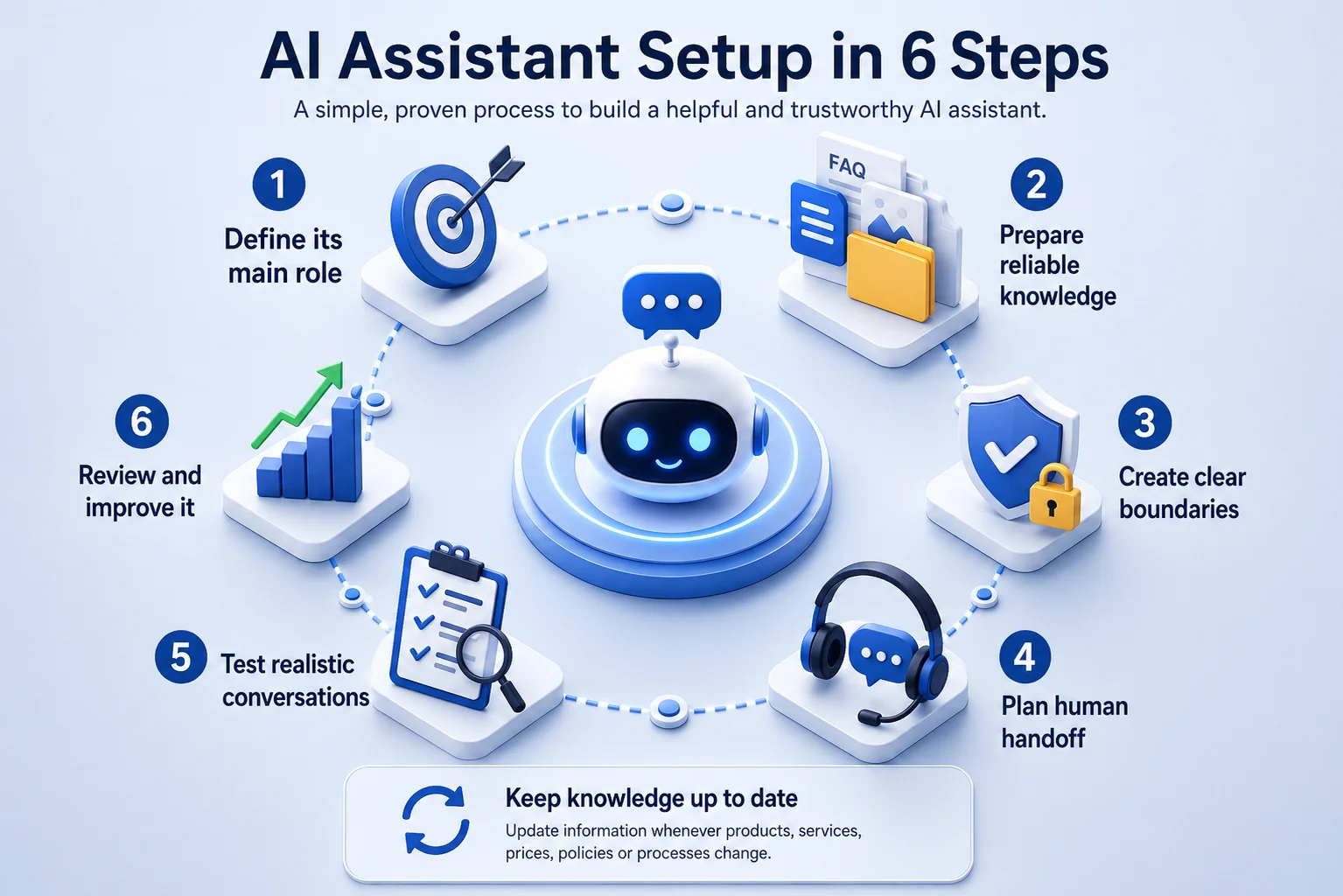
How to Set Up an AI Assistant for Your Website
A useful AI assistant begins with a clear purpose. Do not start by trying to automate every possible conversation.
1. Define its main role.
Decide whether the assistant will primarily answer questions, support customers, guide visitors, capture leads, assist ecommerce shoppers or combine a small number of these goals.
2. Prepare reliable knowledge.
Review your website pages, FAQs, policies, product information, pricing, manuals and support documents. Remove outdated or conflicting information before connecting it to the assistant.
3. Create clear boundaries.
Specify which questions the assistant may answer, what information it may collect and which requests must be transferred to a person.
4. Plan human handoff.
Visitors should have a simple way to reach your team. The handoff should include the previous conversation so the user does not have to start again.
5. Test realistic conversations.
Use spelling mistakes, short messages, follow-up questions, comparisons, unclear requests and questions the assistant should not answer.
6. Review and improve it.
Monitor conversations after launch. Identify inaccurate responses, unresolved questions, repeated handoffs and missing business information.
The knowledge should be updated whenever products, services, prices, policies or business processes change.
What to Look for in a Website AI Assistant
The right platform should match your actual business needs rather than simply offering the longest feature list. Important capabilities include:
Training from website content and documents
Natural follow-up conversations
Easy knowledge updates
Human handoff
Lead capture
Website and business-tool integrations
Conversation analytics
Multilingual support where required
Privacy and access controls
Custom instructions and brand-aligned responses
You should also test whether the assistant admits when it does not know an answer. A confident but incorrect response is more harmful than an honest request for human assistance.
Limitations and Risks to Consider
AI assistants are useful, but they are not always correct. Large language models can produce inaccurate or fabricated responses, especially when the source information is incomplete or the assistant is asked something outside its approved knowledge.
Outdated information is another risk. If a business changes its prices, product details or policies without updating the assistant, visitors may receive incorrect guidance.
Privacy must also be considered. Businesses should understand what information is collected, where conversations are stored, who can access them and how long the data is retained.
Finally, users should not be trapped inside automation. Complaints, payment disputes, sensitive matters, complex technical problems and important business enquiries may need human judgment. A reliable AI assistant recognizes its limits and makes human support easier to access.
How AgentBest.ai Supports Business Websites
AgentBest.ai helps businesses create an AI assistant using their existing website content and additional knowledge.
The platform can scan website pages, products, services, FAQs, policies and other important business information. Users can also add PDFs, manuals, pricing details, support documents and additional FAQs to improve the assistant’s knowledge.
After setup, the AI assistant can be deployed through a website widget. It can answer visitor questions, guide users to relevant information, support customer-service and sales conversations, collect enquiries and transfer more complex requests to the business team.
This approach can support ecommerce stores, SaaS companies, real estate websites, service businesses, education platforms, travel companies and other organizations without requiring them to develop an AI system from the beginning.
Final Thoughts
An AI assistant for a business website makes information easier to access through conversation.
It can help visitors understand products, explore services, find important pages, receive support and contact the right person. For ecommerce businesses, it can also guide product discovery and answer questions that may otherwise delay a purchase.
However, its value depends on accurate business knowledge, clear boundaries, regular testing and reliable human handoff.
The best AI assistant does not try to replace every human conversation. It handles suitable questions quickly, recognizes when it needs help and makes the website feel more useful to every visitor.